
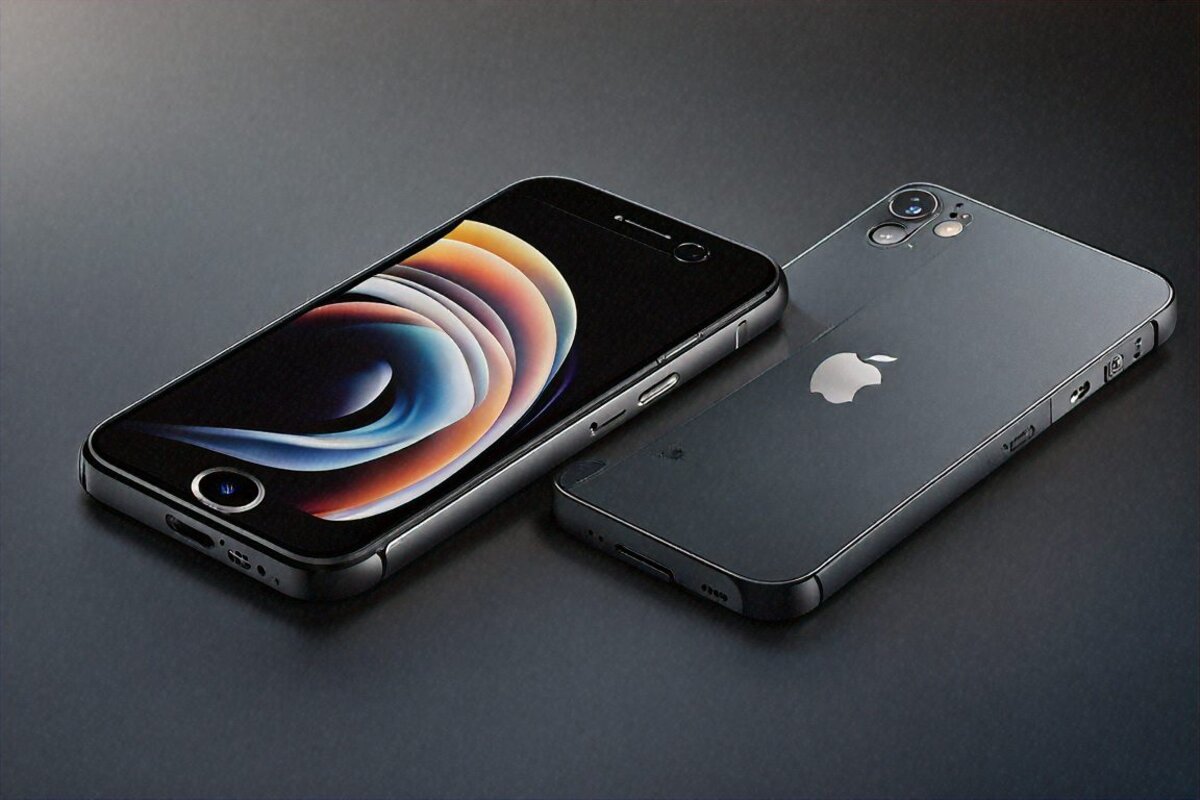
I still remember unboxing the original iPhone SE in 2016. That 4-inch screen, the 5s body with 6s guts crammed inside, and this odd little thrill that Apple had cracked some secret formula — flagship internals in a tiny, cheap shell that didn’t read as a compromise. It felt like a choice. Almost a statement. The SE 2 in 2020 carried the spirit forward with the iPhone 8 body and an A13, and while it wasn’t exciting, it was honest value. The SE 3 in 2022, though? Didn’t land the same. It felt like Apple going through the motions — a new chip in the same tired iPhone 8 shell that was already two years past its sell-by date, still on Touch ID, still chunky bezels, still an LCD while everyone else had moved to OLED and gestures. I wrote at the time that the SE line might be creatively dead.
Then Apple announced the SE 4, and I’ll be honest — I was skeptical. Very. Another SE, ₹49,900 for hardware pulled from older premium models, while Android rivals hand you more features, more cameras, and bigger batteries for less? My first reaction was “who is this actually for?” But here’s where I eat some crow, because three weeks with the SE 4 as my daily driver genuinely surprised me. Not in a “better than I feared” way — in a “this is a really good phone and I enjoy using it” way. It’s the first SE that feels like a real modern phone instead of a nostalgic callback sold at a markup to people who don’t know better.
Some background on where I’m coming from: I’m primarily an Android person. My main phone the past year has been an Android flagship. I live in Google services, I like Android’s customisation, and I’ve been critical of Apple’s India pricing for years. So this comes from an Android user’s chair, biases and all. Keep that in mind.
Why This SE Actually Matters
- Apple A17 Pro chip — the same silicon that powered the iPhone 15 Pro
- Face ID replaces Touch ID for the first time ever on an SE
- 4.9-inch OLED display — first OLED screen on any iPhone SE
- 48MP main camera with optical image stabilisation
- iOS 19 loaded with Apple Intelligence AI features
- Compact body weighing just 167 grams
Design — Finally, a Modern SE
The SE 4 looks like an iPhone. A current one. Sounds obvious, almost silly to say, but for SE buyers staring at the same chunky-bezel, home-button design since 2017, it’s a big deal. Apple’s gone with the iPhone 16 language — flat edges, slim bezels, no home button, gesture navigation. There’s a pill-shaped cutout at the top instead of the Dynamic Island from pricier models (a cost cut, presumably, though Apple would call it a “design choice”), but it’s a clean, modern look that doesn’t scream “budget” the way old SEs did with their foreheads and chins.
Glass front, glass back, aerospace-grade aluminium frame in between. Classic Apple construction, refined over many generations. The tolerances are tight — run a finger along the glass-to-metal junction and there’s no gap, no lip, no misalignment. Button clicks are precise and consistent. The mute switch feels deliberate. Small things that add up to a sense of quality most Android phones, at any price, don’t quite hit. I’ve handled ₹1,00,000-plus Android flagships that don’t feel as precisely put together as this ₹49,900 iPhone.
At 167 grams with a 4.9-inch screen, this thing is tiny by 2026 standards. Genuinely, almost comically tiny. Every time I pulled it out of a pocket after weeks on 6.7-inch Android phones, there was a beat of surprise — “oh right, phones can be this small.” It fits every pocket without thinking about it. Shirt pocket, fine. Tight jeans, fine. Shallow running-shorts pocket, fine. One-handed use isn’t a stretch or a compromise — it’s just how the phone’s meant to work, thumb reaching every corner without shifting your grip. In an industry locked in a screen-size arms race past 6.5, 6.7, even 6.8 inches, the SE 4’s size is either a major draw or a firm dealbreaker, depending entirely on you.
It comes in Black, White, and a new Blue — the Blue is subtle and tasteful rather than electric. IP68 water and dust resistance, same as the flagships. The build is unmistakably Apple, a level of hardware craft that outclasses most Android phones at twice the money. Even as Apple’s cheapest current phone, the fit and finish reads “premium” in a way specs alone can’t.
One thing I couldn’t have guessed from a spec sheet: how much I’d enjoy a small phone again. After months on 6.7-inch flagships that need two hands for most things, picking up the SE 4 felt like sliding on a comfy pair of shoes I’d forgotten I owned. Thumb reaches every corner without finger gymnastics. My pinky doesn’t ache from propping up a heavy slab during one-handed scrolling. I can type with one hand while carrying groceries with the other. There’s a real argument that this form factor is just better for a device that’s mostly a communication tool. Not for content — watching Netflix on 4.9 inches isn’t great for long sessions. But for something that lives in your pocket and gets yanked out a hundred times a day for quick stuff? Small wins in ways big phones can’t.
The OLED Display — It’s About Time, Apple
After three SE generations on LCD screens that looked more embarrassing every year next to OLED rivals (and Apple’s own flagships), the SE 4 finally gets an OLED panel. The difference is hard to overstate if you’ve used an older SE. The SE 3’s LCD looked washed out, greyish in dark scenes, lifeless beside any OLED phone on the same table. Now? Deep blacks that melt the screen into the bezels. Punchy, accurate colours. Sharp text. It’s like cleaning a window you didn’t realise was dirty — suddenly everything’s crisper, and you wonder how you put up with the LCD for so long.
4.9 inches at 2160×1080 means excellent pixel density — higher pixels-per-inch than a lot of bigger phones, because you’re packing the same resolution into less space. Text is razor-sharp at every size. Icons are clean. Photos hold detail when you zoom in. Small screens reward high density in a way large ones don’t always show, and the SE 4 cashes in on that.
True Tone shifts colour temperature to match the room automatically, which keeps the screen easy on your eyes across different lighting — warm and cosy under tungsten, cooler and neutral in daylight, balanced under office fluorescents. After a few days you stop noticing it consciously; switch it off and the screen suddenly looks harsh. One of those Apple features that works so quietly you forget it exists until it stops.
The 60Hz refresh rate is the big display compromise, and it’s the one spec criticism I can’t argue with. Every competing phone at ₹49,900 does at least 90Hz, most do 120Hz, some push 144Hz. Scrolling on the SE 4 after a 120Hz phone is… noticeable. Not bad enough to wreck the experience, but your eyes register it during fast scrolling through feeds or long web pages. Text doesn’t settle quite as smoothly when you stop. Animations feel a touch less fluid in transitions. Dealbreaker? For me, no — a day or two of SE 4-only use and I’d adjusted and stopped thinking about it. But if you’re coming off a high-refresh Android and you’re sensitive to motion, that adjustment period is real, and I won’t pretend it isn’t. Apple likely held it at 60Hz to spare the small 3300mAh battery, and given the battery situation (more on that later), I get the logic even if I don’t love the result.
For content — streaming, social media, photo viewing — the OLED performs beautifully within its size limits. Netflix on 4.9 inches isn’t ideal for marathons or visually spectacular stuff, but for quick clips, YouTube, catching a show on a commute, or a cooking video while you actually cook, it’s perfectly fine. The quality of what’s on screen is excellent; it’s the quantity of screen that limits things.
Camera — One Lens Does More Than You’d Think
Single camera on the back. One lens. 48MP with OIS. No ultrawide for big landscapes. No telephoto for zoomed portraits. No depth sensor, no macro, no multi-lens array. Just one good camera that Apple has optimised the hell out of in software.
I expected to be disappointed. Genuinely. My skepticism said “how good can a single-lens phone realistically be in 2026 when every rival at this price has three cameras?” The answer: pretty good. Better than pretty good in certain situations.
Daylight is genuinely impressive, probably the SE 4’s second-biggest surprise after how much I liked the size. The 48MP sensor grabs crisp, detailed shots with Apple’s signature processing — natural tones that look like what your eyes saw, not a hyper-saturated fantasy. Good dynamic range holds both a bright sky and a shaded foreground in the same frame. Whites that look white, not blue- or yellow-tinted. Skin tones across different Indian complexions render authentically. I took it to a weekend market in Bandra and the photos looked genuinely good — not “good for a single camera,” just good.
Samsung tends to oversaturate for social punch. Google tends to over-sharpen edges for crispness. Xiaomi tends to over-smooth skin to flatter. Apple mostly just gets the colours and processing right for how the scene actually looked. That accuracy won’t churn out the most Instagram-ready shots without filters, but it makes photos that feel honest and true to the moment, which I personally value more.
Portrait mode works surprisingly well for one camera, and that’s where Apple’s computational chops flex hardest. With no depth sensor or second lens to measure distance, Apple uses machine learning to estimate depth from a single 2D image — essentially guessing where the background sits from training on millions of photos. The results are convincingly natural for most shots. Simple backgrounds — walls, open sky, blurred streets — produce excellent bokeh that looks like genuine optical blur. Complex backgrounds with trees, crowds, or several depth planes sometimes trip the algorithm into slightly unnatural transitions, but that’s a minor gripe given it’s simulating with one lens what normally takes two.
Night mode exists and does a respectable job. Indoor low-light shots come out clean and usable with good noise control — restaurants, parties, warmly lit living rooms all give you photos you’d happily share. Outdoor night is acceptable but clearly not at the level of multi-lens flagships with bigger sensors and dedicated night modes stacking multiple exposures — the single sensor just can’t gather as much light, and physics beats software in real darkness. For Instagram stories and quick sharing, night mode’s fine. For serious low-light work, you’ll want a different phone or a real camera.
The missing ultrawide and telephoto is the real, practical limit you’ll feel most often. Group shots in tight spaces — a small flat, a restaurant table, a narrow street? You’ll have to physically back up, which isn’t always possible. Want to zoom across the street at a bird in a tree or a distant sign? Digital crop is all you’ve got, and it falls apart fast past 2x, turning to mush by 5x. If those are common shots for you — group photos at gatherings, distant subjects while travelling — the single camera will feel restrictive in ways a spec comparison doesn’t fully convey. You won’t miss the ultrawide until the moment you need it, and then you’ll really miss it.
Performance — Flagship Power, Genuinely
A17 Pro. The chip from the iPhone 15 Pro. In a ₹49,900 phone. Sit with that for a second, because the performance fallout is real.
This phone is faster than Android flagships costing ₹80,000-plus. Not hyperbole, not fanboy posturing — Apple’s silicon lead is huge, and the A17 Pro is still one of the most powerful mobile chips ever made. The gap between Apple and the best Qualcomm has narrowed lately, but it’s still there in sustained performance, efficiency, and single-core work. Apps open instantly. Face ID authenticates in milliseconds — faster than any fingerprint reader I’ve tested on any Android. Switching between a dozen apps shows zero lag or reloading. Genshin Impact runs smoothly at medium-high. The phone never once felt slow across three weeks — not under load, not multitasking, not even during heavy background activity.
iOS 19 with Apple Intelligence adds practical AI that runs entirely on-device rather than via the cloud, a real privacy edge over cloud-dependent setups. Writing Tools rewrite, proofread, and adjust the tone of emails and messages. Photo cleanup removes unwanted objects with a tap. Smart replies and message summaries cut the friction of staying on top of things. Siri’s gotten meaningfully sharper — multi-step tasks, context held across follow-ups, interaction with what’s on screen in ways older versions couldn’t. These run locally on the A17 Pro’s Neural Engine, so they work offline and your data never leaves the device. That last bit matters more than most people realise.
Battery is the SE 4’s achilles heel, the one weakness I can’t justify or wave away, and I won’t sugarcoat it. The 3300mAh cell is small. In a world of Android phones routinely packing 5000-5500mAh, 3300mAh feels like bringing a water bottle on a desert trek. Heavy use — gaming, streaming, constant scrolling, navigation, camera — drains it by early evening, somewhere between 3 and 5 PM depending on intensity. Moderate use — messaging, some social, occasional photos, light browsing — gets you through the day, but barely, finishing around 10-15% by bedtime. I found myself reaching for the charger around 4-5 PM on busy days, which I never do with Android phones in this price range.
iOS efficiency helps more than the raw number suggests — Apple wrings more screen time out of 3300mAh than most Android makers get from bigger cells, thanks to tight hardware-software tuning. But software magic only goes so far when the physical battery is this small, and power users will feel it daily.
25W wired charging does zero to 50% in about thirty minutes, okay for an emergency top-up before heading out. A full charge takes longer — roughly 90 minutes from zero, slow by 2026 standards. There’s 15W wireless via Qi (not MagSafe — another cost cut, so you lose the magnetic alignment of MagSafe accessories), so you can drop it on a pad at your desk for passive charging through the day. That passive desk approach is honestly the smartest way to manage the battery — keep it topped up rather than banking on one overnight charge to last till bedtime.
All the Specs in One Place
| Specification | Details |
|---|---|
| Processor | Apple A17 Pro |
| RAM | 8GB |
| Storage | 128GB/256GB/512GB |
| Display | 4.9-inch OLED, 2160×1080, 60Hz |
| Main Camera | 48MP f/1.6 with OIS |
| Front Camera | 12MP TrueDepth Face ID |
| Battery | 3300mAh |
| Charging | 25W wired, 15W wireless |
| OS | iOS 19 |
| IP Rating | IP68 |
| Weight | 167g |
Pros & Cons
Pros
- A17 Pro delivers flagship iOS performance at ₹49,900
- Compact 4.9-inch size — the only premium small phone left
- Face ID finally arrives on the SE line
- iOS 19 with Apple Intelligence running on-device
- Most affordable way into the Apple ecosystem in 2026
Cons
- 3300mAh battery won’t last heavy users through a full day
- Single 48MP rear camera — no ultrawide or telephoto
- 60Hz refresh rate when competitors offer 120Hz
- No MagSafe — only basic Qi wireless charging
Software, Connectivity, and the Ecosystem Factor
iOS 19 is iOS 19. If you’ve used an iPhone, you know the deal — smooth, stable, secure, consistent, and opinionated about how you should do things. The animations are polished. App quality is generally higher than Android equivalents. Updates land on day one for everyone at once instead of trickling out over weeks like Android. If you haven’t used iOS, the switch from Android is real but manageable — most people I’ve watched make the jump settle in within a week, though certain Android habits (back-button muscle memory, default apps, file management) take longer to unlearn.
Apple’s software support is legendary and unmatched on any platform. This phone will probably get iOS updates for five to six years, going by Apple’s track record — the iPhone 8, from 2017, got updates until 2023. That’s not a marketing promise; it’s a demonstrated pattern. An SE 4 bought today will still feel current, secure, and supported in 2031 or even 2032. No Android maker comes close — Samsung’s four years of OS updates is the best Android offers, and even that’s two years shy of what Apple delivers as routine. For the many Indian buyers who keep phones three to four years, that long tail means it’s still getting new features and patches when you finally replace it, which helps both daily experience and resale value.
5G works across all Indian carriers — Jio, Airtel, Vi. Wi-Fi 6E and Bluetooth 5.3 handle wireless duties capably with no connectivity hiccups in testing. NFC powers Apple Pay, though Apple Pay’s adoption in India is still thin next to Google Pay — most POS terminals I tried work with Google Pay but not all support Apple Pay, so you’ll want a UPI app installed as backup for now. AirDrop for instant file sharing with other Apple devices, iMessage for the Apple crowd (and it’s everywhere — group chats, family threads, work chat all drifting to iMessage among iPhone users), and FaceTime for video calls that actually work without a third-party app. These ecosystem hooks are sticky for a reason — once you’re in, leaving gets harder as your social circle’s communication settles around Apple’s services.
Speaking of the ecosystem — this is the part where the SE 4 makes its strongest case, one that goes beyond any single spec. An AirPods user who wants automatic switching and spatial audio. A MacBook user who needs iMessage, AirDrop, Universal Clipboard, and Handoff. An Apple Watch wearer who literally needs an iPhone to pair (the Watch doesn’t work with Android at all). A family where everyone else is on iMessage. A student who takes notes on an iPad and wants Handoff to just work between devices. These people — and they number in the millions in India — all point at the SE 4 as the cheapest way into Apple’s interconnected world. The phone becomes more than the sum of its specs once it’s part of a bigger system.
Okay, I’ll Admit My Bias — And Where I Was Wrong
I walked into this fully ready to write the SE 4 off as overpriced and under-featured. At ₹49,900 you get a 60Hz screen, one camera, a small battery, and no real fast charging. Android phones at that price give you 120Hz, triple cameras, 5000mAh, and 100W charging. The spec comparison isn’t even close, and I had a review half-written in my head that said “fine if you need an iPhone, but any rational buyer should pick Android at this price.”
Three weeks of daily use later, I have to admit the spec sheet doesn’t capture what makes this phone good, and my pre-formed conclusion was wrong. It doesn’t show the consistency and natural accuracy of the camera across hundreds of shots. It doesn’t convey how genuinely nice it is to carry a 167-gram phone that fits every pocket and works one-handed. It doesn’t measure five to six years of updates keeping the phone current and secure well into the next decade. It doesn’t quantify how well Apple Intelligence runs with everything processed on-device by the A17 Pro — no cloud, no privacy worry, no internet needed.
And it certainly doesn’t capture the ecosystem glue that makes an iPhone more than its parts. When your AirPods auto-connect, your Mac grabs the text you copied, your Apple Watch unlocks your phone, and your FaceTime rings on every Apple device at once — that interconnectedness layers on a daily convenience no spec sheet can show but every Apple user takes for granted.
I’m an Android person, mostly. I still think Android offers better customisation, better raw value at most price points, more hardware variety, and more choice overall. Three weeks with the SE 4 didn’t change any of that. But I’d be dishonest, professionally and personally, if I didn’t admit the SE 4 has a charm, a coherence, and a thoughtfulness that’s hard to replicate by just stacking better specs into a chassis. Apple has made a genuinely compelling compact phone, and my early skepticism was — I’ll say it plainly — wrong.
For small-phone lovers the rest of the industry abandoned, for Apple-ecosystem users after the cheapest way in, for people upgrading from older iPhones who want modern features without flagship money, or for anyone who values software longevity and build quality over spec-sheet maxing — the SE 4 is the easy recommendation. Just buy a wireless pad for your desk and keep a power bank in your bag. The battery is the toll you pay for everything else this phone gets right.
Price in India
The iPhone SE 4 starts at ₹49,900 for the 128GB version, which is enough storage for most people. The 256GB makes sense for heavy photo and video shooters, and the 512GB is probably overkill unless you hoard games or keep a big offline media library. Grab it from Apple India, Amazon India, Flipkart, or any authorised reseller — availability’s been good since launch with no shortages I’ve noticed. Pro tip: exchange deals on Amazon and Flipkart have been aggressive lately — an old iPhone 11 or 12 in decent shape can knock ₹10,000-15,000 off, making the SE 4 a much easier upgrade for the millions still holding older iPhones and waiting for the right moment.
Full Specifications
| Processor | Apple A17 Pro |
|---|---|
| RAM | 8GB |
| Storage | 128GB/256GB/512GB |
| Display | 4.9" OLED 60Hz |
| Main Camera | 48MP f/1.6 OIS |
| Battery | 3300mAh |
| Charging | 25W wired, 15W wireless |
| OS | iOS 19 |
| IP Rating | IP68 |
| Weight | 167g |
Pros
- A17 Pro chip delivers flagship iOS performance at ₹49,900
- Compact 4.9-inch size for one-handed use
- Face ID added for the first time on SE
- iOS 19 with Apple Intelligence features
- Most affordable iPhone in 2026
Cons
- Small 3300mAh battery struggles through a full day
- Only one 48MP rear camera
- No ProMotion display — 60Hz refresh rate only
- No MagSafe wireless charging
Our Rating: 8.3/10 · Price: ₹49,900
0 Comments