
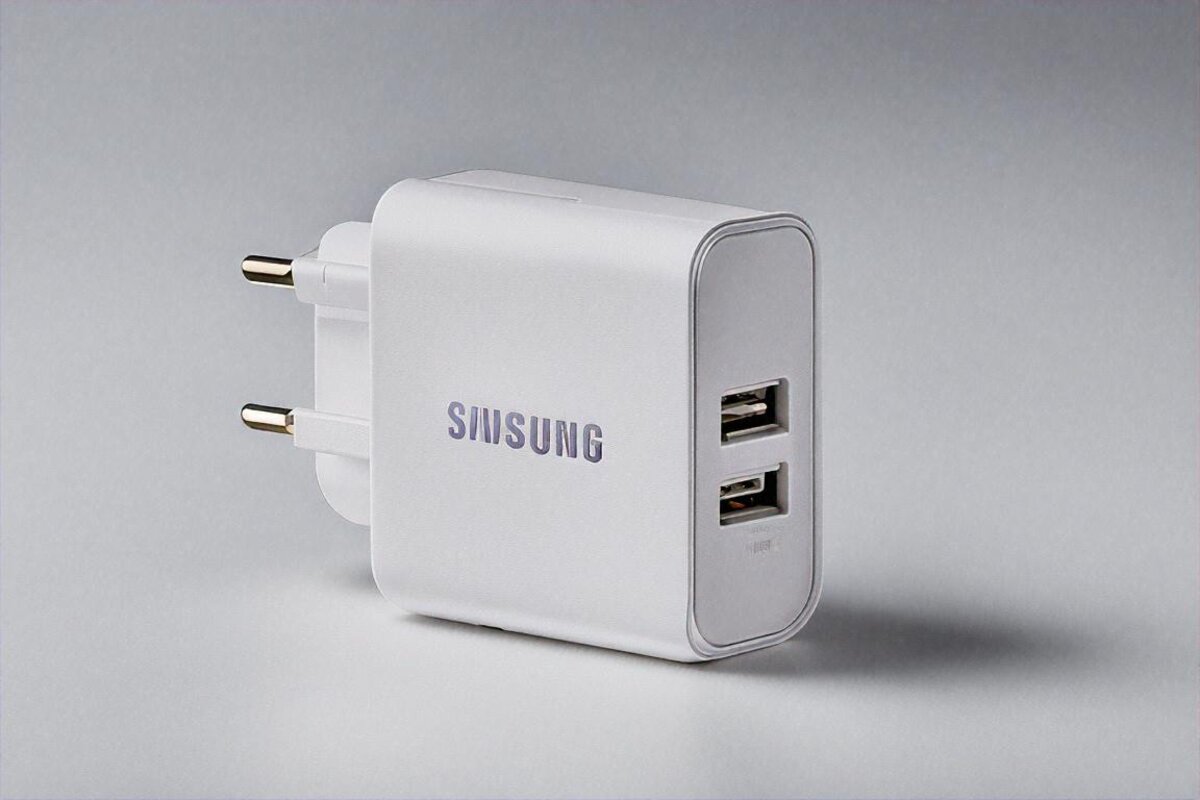
Right, this has been rattling around my head for a while, and yes, it’s faintly absurd to hold this many opinions about a charger. Stick with me though. By 2024 the average Indian tech person is lugging at least three things that need a daily charge — phone, earbuds, a watch or tablet — and the tangle of cables and bricks we’ve all quietly accepted is genuinely one of the more irritating small problems in life. Samsung’s 45W Travel Adapter Trio, ₹3,499, sets out to fix that. One adapter, three ports, 45W off the USB-C, small enough to travel with. I ran it as my only charger for about two months — everyday life in Bangalore, a week of work in Hyderabad, a family stretch in Goa — and I came away with thoughts. A lot of them.
First, what’s actually in the box: the adapter, a slim instruction leaflet no one will read, and nothing else. Samsung wants ₹3,499 and won’t toss in a single cable. I know everyone has a drawer of cables — I’ve got maybe fifteen scattered across mine — but at this money, even a basic 1-metre USB-C to USB-C lead would’ve been a decent gesture. Anker manages it. Baseus manages it. Samsung seems to reckon the badge alone covers the bare packaging. Mildly annoying. Let’s move on.
The adapter itself is pleasingly small. Not the smallest going — Anker’s Nano series wins on pocketability — but for something carrying 45W of USB-C Power Delivery plus two USB-A ports, the footprint is fair. About two matchboxes stacked. White plastic, a glossy finish that grabs fingerprints but wipes clean, and prongs that fold flat for travel. Those folding prongs matter more than you’d guess. I’ve owned chargers with fixed prongs that punched holes in the lining of my laptop bag. These tuck away and the whole thing slips into a pocket without snagging on anything. Tiny design call. Real difference day to day.
Weight sits around 107 grams. You won’t feel it in a bag. You barely feel it in a jeans pocket, which is how I carried it through Goa, because digging through luggage every time I wanted to charge something at a cafe got old fast. For a three-port 45W charger, that weight is genuinely impressive. My old kit was a 25W Samsung brick, a separate dual-USB charger, and a thin extension board just in case — roughly 350 grams together and a lot more bulk. Consolidation is the whole pitch here, and it delivers on that from the off.
Now, what those three ports actually do, because Samsung’s marketing goes vague on power distribution and I had to work some of it out by testing. The USB-C port pushes up to 45W on its own. It backs USB PD 3.0 and PPS (Programmable Power Supply), which is what lets it fast-charge the Galaxy phones rated for 45W — your S23 Ultra, the S24 line, the Galaxy Tab S9 and newer, a handful of others. Plugged into my Galaxy S24 Ultra, the “Super Fast Charging 2.0” banner popped up straight away. 0 to 50% in about 26 minutes. 0 to full in roughly 62. Those line up with what Samsung’s own 45W single-port brick does, so there’s no penalty for picking the Trio over the dedicated charger. Good.
Here’s where it gets interesting and slightly irritating. Plug into more than one port at once and the power gets shared. The USB-C drops from 45W to about 25-27W the moment either USB-A port is in use. The two USB-A ports top out at 15W each, and in real testing I clocked them nearer 10-12W when both were going at once. So if you’re charging the S24 Ultra on USB-C while feeding earbuds and a watch off the USB-A ports, your phone is no longer pulling 45W. It’s pulling roughly 25. Still quick. Just not the “Super Fast Charging 2.0” splashed on the box — the banner on my phone actually flipped from “Super Fast Charging 2.0” to plain “Fast Charging” the second I added a device. Not a dealbreaker, 25W charges plenty fast, but the marketing nudges you to believe every port runs flat-out together. It doesn’t. Samsung ought to be clearer about that.
I tried it with non-Samsung gear too, since not every Indian household runs a full Galaxy setup. My partner’s iPhone 15 took about 20W off the USB-C, which is the most a 15 will accept over PD anyway, so no grumbles there. A Pixel 8 drew around 21W. An iPad Air landed near 20W. Cross-brand compatibility is solid — not one device refused to charge or threw an error. The USB-A ports handled everything from ₹500 earbuds to a Kindle to an old OnePlus Nord on its original USB-A cable. Nothing clever on the USB-A side — no Qualcomm Quick Charge I could detect, just plain 5V/3A — but for what you’d usually plug into USB-A in 2024 (earbuds, watches, power banks, older phones), that’s fine.
Heat. I have to bring up heat, because Indian summers plus charger heat is a combo that makes me twitchy. On single-port 45W charging the adapter gets noticeably warm. Not uncomfortable to hold, but warm enough that you can tell it’s grafting. I measured the surface at around 48 degrees Celsius after 30 minutes at 45W in a room sitting at about 34 (no AC, a Bangalore afternoon). Within safe limits, but warmer than I’d like. With all three ports active it climbed to about 52 degrees. Still in spec. Still enough to make me slightly uneasy leaving it in a power strip resting on a wooden desk. I started parking it on a ceramic coaster during heavy sessions, which felt daft and also felt like the sensible thing to do. For what it’s worth, there’s internal thermal protection that throttles output if it overheats. It never actually kicked in during my testing, but knowing it’s there settles the nerves a bit.
Indian grid compatibility is something most reviews skate past, and it matters. The adapter takes 100-240V input, so voltage swings — very much a real thing in parts of India, especially tier-2 and tier-3 cities — shouldn’t trouble it. I ran it in Goa, where the supply at our beach-side Airbnb was, let’s say, temperamental. The lights flickered now and then. The Samsung never flinched, charging straight through the dips. Compare that with a cheap third-party charger I used to own that would restart its whole charge cycle every time the voltage sagged. The regulation here is rock solid.
One situation where it really earned its place: airport charging. Outlets at Indian airports are scarce, contested, and often shared with strangers. Three ports meant I could charge my phone, hand the USB-A over to my partner for her earbuds, and still keep a port spare to top up my watch — all from one wall socket. One plug point. In a country where an airport outlet sometimes gets split six ways between people eyeing each other warily, that’s a real upgrade to the day. I’m probably making it sound grander than it is. But if you fly domestic a lot, you know exactly the scene I mean.
Durability’s been fine across two months. No yellowing of the white plastic, which on cheaper chargers happens depressingly fast in Indian dust and humidity. The fold-out prong still snaps firmly into place, no wobble. The USB ports keep a good grip on connectors. Build quality is about what you’d expect from Samsung — feels premium without feeling over-engineered. It’s a charger. It doesn’t need to survive a cliff fall. It needs to shrug off daily tossing into bags and drawers, and so far it has.
Let me deal with the obvious objection: ₹3,499 for a charger is, plainly, a lot of money. The Anker 735 GaNPrime 65W three-port goes for about ₹3,200-₹3,500 and hands you a lot more total wattage. The Portronics Adapto 45W turns up under ₹1,500. Amazon’s awash with triple-port chargers from Ambrane, boAt, and Stuffcool in the ₹800-₹1,500 band. So why pay the Samsung tax? Honest answer: tested PPS compatibility with Samsung phones (which is what gets you 45W — not every third-party charger reliably trips Super Fast Charging 2.0), Samsung’s thermal management and safety certs, and the comfort of a brand that’ll still be around when you need a warranty claim. Whether that argument lands depends entirely on how you feel about third-party brands. I’ve used good Anker chargers. I’ve also owned a no-name Amazon one that started smelling of burning plastic after three months. Your mileage will vary. Literally.
Samsung’s own pricing makes for an odd comparison too. Their dedicated 45W single-port (the EP-T4510) runs about ₹2,199. The 35W Duo is around ₹2,499-₹2,799. The Trio at ₹3,499 is only ₹700 to ₹1,300 over those, and gives you a third port plus the higher 45W. Inside Samsung’s own range, the Trio is actually the best value. If you’re already locked into the Samsung world and were going to buy one of their chargers anyway, the Trio is the obvious pick. Marginally pricier, does a fair bit more.
I’ve been chewing on who exactly should buy this and who should skip it. If you carry a few Samsung Galaxy devices — phone, buds, watch, tablet — and you want one charger for the lot, this is about the tidiest answer out there. Tested, compatible, right-sized, travel-ready. If you own a single device that needs charging, or you don’t care about Samsung’s fast-charge protocols, the Anker options give you more raw watts per rupee. For the Samsung-ecosystem traveller, this is close to a perfect product. For everyone else, it’s a good charger at a slightly premium price that you could match for less with another brand.
What would I change? Include a cable. Honestly. Even a stubby 30cm USB-C would lift the unboxing from “that’s it?” to “oh, nice.” I’d also love the USB-A ports to support Quick Charge for the older gear that leans on it — my dad’s Redmi Note 11 does QC3.0 but not PD, so it crawls off this adapter’s USB-A ports. Not Samsung’s fault that Xiaomi rides Qualcomm’s protocol, but a charger badged “Trio” really ought to play nice with whatever you hand it. A tiny per-port charging LED would be welcome too. Right now you plug something in and just trust it’s charging. Usually it is. But a green light would be reassuring.
A couple of small gripes that surfaced over time. The glossy white shows scuff marks from rattling around bags with other stuff. After two months mine has a few faint scratches up top. Purely cosmetic, no effect on function, but a matte finish would’ve aged better. Also, the adapter is just a hair too thick for some of those cramped older Indian double-socket setups where two three-pin points sit side by side. Plug the Trio into the left socket and it can half-block the right one, depending on the layout. Not universal — it fit fine in most outlets I met — but it happened twice on the Hyderabad trip and once at home. Worth knowing if you’re in an older building with tight wiring.
USB-C PD 3.0 and PPS support is more important than it sounds, and I should spell out why. Older PD adapters without PPS will charge a Samsung phone at only 25W even when the brick is rated higher. PPS is the bit that frees up 45W on Samsung devices. Loads of third-party adapters advertise 45W or 65W but skip PPS, so they charge a Galaxy S24 Ultra at just 15-25W rather than the full 45. Samsung’s own adapter obviously has PPS, so you’re guaranteed the top charging speed your phone can take. I’ve watched people buy “65W” bricks off random Amazon sellers and scratch their heads over why their Samsung only reads “Fast Charging” instead of “Super Fast Charging 2.0.” This is why. Protocol support beats raw wattage numbers.
The travel angle deserves a push, because domestic air travel in India has gone vertical over the last five years. Forty or fifty domestic flights a year is nothing unusual for people in consulting, sales, or tech. Every one of those trips brings a charging panic at some point — the airport, the hotel, the client site with no free socket. One small adapter that covers everything means one less thing to pack, one less thing to forget, one less thing to fail. I left my Hyderabad hotel charger behind once during this review. Clocked it at the airport. And because the Trio was handling everything, it was the only charger I’d brought — so I had to grab a dreadful ₹400 charger from an airport shop to get through a flight delay. That little disaster made me appreciate the Trio more. When it works (which is always), you forget it’s there. You only notice it when it isn’t.
Two months in, my verdict’s pretty plain. The Samsung 45W Travel Adapter Trio does exactly what it says — charges three things at once, runs Samsung-optimised fast charging on the USB-C port, stays reasonably cool, travels well, feels built to last. It does nothing surprising or thrilling, because it’s a charger and chargers shouldn’t be thrilling. They should be reliable. This one is. At ₹3,499 it isn’t the cheapest, but it’s the one I trust most, and when you’re plugging something into an Indian socket every night that sits by your bed while you sleep, trust counts for more than saving eight hundred rupees.
I was going to tie this off neatly, but honestly there’s no neat ending to a charger review. It works. I use it every day. I’d buy it again at full price, though I’d also tell you to watch Amazon and Flipkart during sale events, since I’ve seen it slip to ₹2,799 during
Quick Reference
Rating: 8.2/10
Price: ₹3,499
Pros:
- 45W USB-C with PD 3.0 and PPS — triggers Samsung Super Fast Charging 2.0
- Three ports (1x USB-C + 2x USB-A) from a single compact adapter
- Foldable prongs make it genuinely travel-friendly
- 107g weight — lighter than most three-port alternatives
- Handles 100-240V input without issues in Indian power conditions
- Works well with non-Samsung devices (iPhone, Pixel, iPad)
- Good thermal management with internal protection
Cons:
- No cable included at ₹3,499 — feels stingy
- USB-C drops to ~25W when other ports are active — not clearly communicated
- USB-A ports lack Quick Charge support for non-PD devices
- Glossy white finish scuffs easily over time
- Slightly bulky for some older Indian double-socket outlets
- No LED charging indicators on any port
Pros
- 45W USB-C with PD 3.0 and PPS — triggers Samsung Super Fast Charging 2.0
- Three ports (1x USB-C + 2x USB-A) from a single compact adapter
- Foldable prongs make it genuinely travel-friendly
- 107g weight — lighter than most three-port alternatives
- Handles 100-240V input without issues in Indian power conditions
- Works well with non-Samsung devices (iPhone, Pixel, iPad)
- Good thermal management with internal protection
Cons
- No cable included at ₹3,499 — feels stingy
- USB-C drops to ~25W when other ports are active — not clearly communicated
- USB-A ports lack Quick Charge support for non-PD devices
- Glossy white finish scuffs easily over time
- Slightly bulky for some older Indian double-socket outlets
- No LED charging indicators on any port
Our Rating: 8.2/10 · Price: ₹3,499



0 Comments