
Picture it: the marble floor of your new Noida flat, just mopped by the house help, and your iPhone 17 Pro slipping out of your kurta pocket in slow motion. You watch it go. Then the crack. I’ve lived that exact moment — twice. Once with an iPhone 12, once with a 14 Pro. No case either time. And both times I swore I’d learn the lesson.
So with the iPhone 17 Pro, before I’d even peeled the film off the screen, I ordered the Spigen Tough Armor from Amazon. At ₹1,999 it’s not the cheapest case out there, and it’s not pretending to be. The pitch is that it’s the last case you’ll buy for this phone, and after roughly six weeks of daily use across Mumbai and Delhi, I think it might actually pull that off.
One thing up front: I’m rough on phones. They live in back pockets. They get flung onto restaurant tables. My three-year-old has grabbed one more than once and chucked it across the room, because that’s the job description of a three-year-old. If you treat your phone like a Faberge egg, you can probably skip this case. But if you’re built like me — clumsy, distracted, always five minutes late — read on.
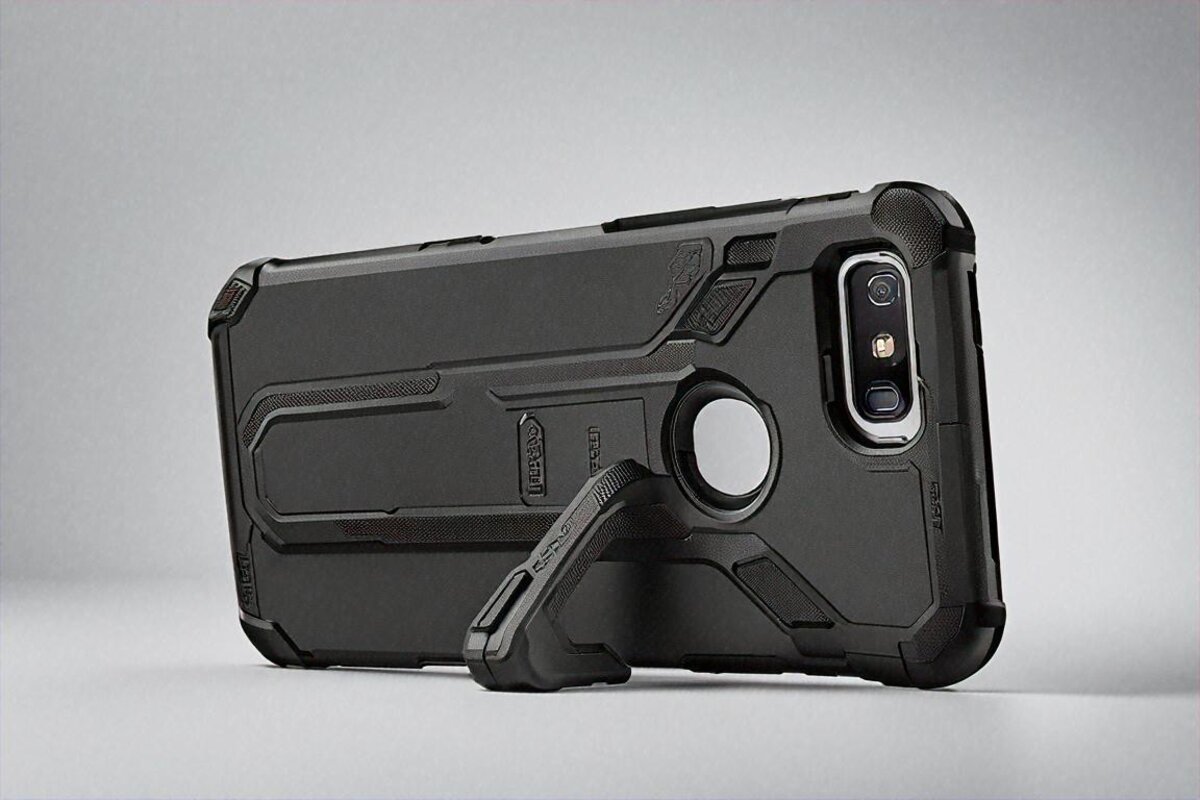
Start with what’s in the box. Spigen has dropped the fancy packaging, which I’m glad about — a cardboard sleeve, the case, a tiny instruction card nobody opens. No pointless plastic. The case is two pieces: a soft TPU inner layer that grips the phone, wrapped in a hard polycarbonate outer shell. Look closely and you can spot the seam where they meet, but it’s tight. No wobble, no flex, no gaps.
Weight worried me first. The iPhone 17 Pro already lands around 199 grams, and the Tough Armor piles on another 52 or so. Call it 251 grams in the hand combined. Honestly? Two days in and I’d stopped noticing. Your hand recalibrates. If you’re switching from something paper-thin like the Peel or one of those ₹199 clear TPU sleeves from Croma, sure, you’ll feel it for a day.
Grip beats weight, though, and the back has that matte-ish texture Spigen’s been doing for a few generations. Not quite soft-touch, not quite hard plastic — somewhere in the middle, and the upshot is a grip that genuinely holds. My palms sweat, especially in Mumbai’s humidity, which from March onwards is its own special torment, and this case doesn’t slide. Can’t say that for Apple’s silicone case, which turns weirdly tacky in humid weather and then skates around once your hands dry out. Make it make sense.
The buttons earn a mention, because bad button feel can sink an otherwise good case. Spigen nails it. Both volume buttons and the power button get individual covers with a tactile click that lands surprisingly close to the bare buttons — maybe a 10-15% bump in the force you need, but it still feels right. The Action Button gets a cutout rather than a covered button, which I reckon is the correct call. You want the real hardware texture under your thumb for something you map to different functions.
The Kickstand Nobody Asked For (But Everyone Uses)
Right, the kickstand. I’ll come clean — when I first saw it on the Tough Armor years back, I wrote it off as a gimmick. A little metal flap that props your phone up? Sure. But I’ve done a full reversal on this. It’s probably the feature I use most on the whole case, which feels strange to admit about a case feature.
Here’s a typical day. Morning, phone propped on the kitchen counter playing a Dhruv Rathee video while I make chai. Afternoon, propped on my office desk through a long Zoom call so I’m not holding it or balancing it against a water bottle. Evening, propped on the nightstand for a YouTube video before bed. That little metal stand gets deployed three or four times a day, easy.
It locks at a single angle — somewhere near 60 degrees — which suits wide-screen viewing but not portrait. Some people moan about that. Fair. But I’d take one rock-solid angle over a flimsy multi-angle hinge that goes loose in a month. Six weeks on, this one still clicks firmly into place. We’ll find out how it holds at six months, but the early signs are good.
One thing that does bug me: the kickstand is useless on soft surfaces. Trying to stand the phone on a bedsheet or a couch cushion? Don’t bother. It wants a hard, flat surface. Kitchen counter, desk, airline tray table — all fine. A blanket? It just slides down. Minor gripe, but worth flagging, since a lot of us watch stuff in bed.
Now the bit that actually matters with a case like this: drop protection. Spigen claims MIL-STD-810G certification, the American military standard for equipment durability. Sounds heavy-duty, and it sort of is, but I’d point out that the standard means specific lab-controlled drops from 1.22 metres onto plywood. Real life doesn’t follow that script.
Real life is your phone tumbling off your lap as you stand up from an auto rickshaw. Real life is it sliding off a slanted table at a Starbucks and hitting tile corner-first. Real life is your kid hurling it down a staircase. I’ve lived two of those three during testing (you can guess which two), and the phone came out of both without a scratch.
The first drop was from about waist height onto a tiled floor at a restaurant in Connaught Place. It landed on its corner. I picked it up, checked it over — nothing. Not even a scuff on the case, let alone the phone. The raised lip around the camera module (about 1.5mm) and the raised bezel around the screen (about 1.2mm) were doing precisely their job: keeping the vulnerable parts off the ground entirely.
The second drop was nastier. The toddler got hold of it and threw it hard across the living room. It clipped the edge of a wooden coffee table, bounced, and hit the floor. My heart genuinely stopped for a beat. But again — the phone was fine. A small scuff turned up on the case’s corner, the kind of thing I’d never have clocked if I weren’t hunting for damage. Six weeks in, the phone underneath looks like it did on day one.
I’m not going to pretend I ran scientific drop tests with measuring tape and slow-motion cameras. I didn’t. What I can say is that in normal, messy, Indian daily life — where the floors are marble or tile and things hit the deck regularly — this case does its job. Whether that’s worth ₹1,999 over a ₹499 case from Amazon Basics is a separate question. For most people I’d say yes. You’re not just buying plastic. You’re buying the engineering of how that plastic soaks up and spreads impact across the dual-layer build.
Port access is fine. The USB-C cutout at the bottom is generous, so even chunkier third-party cables slot in without a fight. The speaker grilles sit fully open. I want to flag MagSafe specifically, because I’ve seen mixed reports floating around online.
My experience: MagSafe works, but the magnetic pull is clearly weaker than going caseless — I’d guess about 70% of the bare-phone strength. My MagSafe wallet stayed put through normal use but slid off once when I yanked the phone out of a tight jeans pocket. The MagSafe charger held fine overnight, never dropped. So it works; just don’t expect the same satisfying snap you get without a case.
Wireless charging in general gave me no trouble. I tested both Apple’s MagSafe puck and a generic Qi2 pad from Ambrane, and both charged at their expected speeds. No overheating either, which can be a problem with thicker cases that bottle up heat. The Tough Armor seems to shed heat well enough, though I did notice the back getting warm during long charging sessions in Delhi’s summer. Not hot. Warm. Nothing to fret over.
Camera bump accommodation is another spot Spigen gets right. The camera module on the 17 Pro is enormous — Apple really went big on the lenses this year — and the Tough Armor’s cutout leaves it plenty of room without looking comically oversized. Set the phone face-up on a table and it sits flat, because the case’s raised edges sit level with the camera bump. Sounds basic. You’d be amazed how many case makers botch this and leave the phone rocking like a see-saw every time you tap the screen.
Six weeks is long enough to talk durability with some confidence, not long enough for a final verdict. Here’s what I’ve clocked so far: the matte finish hasn’t yellowed. Zero discoloration. That’s a big deal, because one of the standard complaints about cheaper cases — clear ones especially — is that they turn yellow within weeks, and Indian humidity and sweat only speed that up. The black colourway I’m running shows no signs of ageing at all.
The polycarbonate outer shell has picked up a couple of faint scuffs from the drops, but nothing you’d spot from normal viewing distance. The TPU inner layer still fits snugly — no stretching, no loosening at the corners. The kickstand hinge is as firm as day one. Button covers still click properly. On the whole, it feels built to last, which is exactly what you want for something that cost you two grand.
I’ve also had it through dusty conditions — Delhi in March is basically a dust bowl — and the case doesn’t pack grime into the seams or around the buttons the way some do. A damp cloth cleans it. Five minutes and it looks new again.
Worth being clear about what this case isn’t. It isn’t slim. If looks and pocketability top your list, go elsewhere — Spigen’s own Thin Fit is more your speed. The Tough Armor is for people who put protection above all else and will swallow a thicker, heavier phone in return for peace of mind.
It also isn’t cheap-looking, which sounds like an odd thing to clarify, except there’s a perception that protective cases are all bulky, ugly slabs that make an expensive phone look like a power tool. The Tough Armor is understated. Black on black, clean lines, barely any branding beyond a small Spigen logo low on the back. Nobody’s going to glance at it and think “rugged case.” They’ll just see a black iPhone with a nice case. Which is the whole idea.
And it isn’t a stand-in for a screen protector. The raised bezels cut down on screen contact in a face-down drop, but a direct hit on the glass itself? You still need tempered glass for that. I’m running a Spigen EZ Fit screen protector alongside the case, and the two play nicely — the protector sits just under the case’s raised lip, so it’s doubly shielded. Pair them and you’ve got a phone that can take real life without drama.
Who Should Buy This?
Parents of young kids. People who work in the field — site engineers, delivery riders, real estate agents in and out of properties all day. Anyone who commutes on Mumbai locals or the Delhi Metro at rush hour, where phones get bumped and shoved constantly. Butter-fingered types like me who drop things. If your phone lives a life of mild to moderate physical risk, this is your case.
Who should skip it? People chasing the thinnest possible profile. People who swap cases to match outfits (apparently a thing now, and no judgment, just different priorities). People who lean entirely on MagSafe accessories with weaker magnets — the dialled-back magnetic strength might wear on you over time.
At ₹1,999 on Amazon India, the Spigen Tough Armor sits in a crowded patch. Below it you’ve got the Ringke Fusion-X around ₹1,299 and the Caseology Parallax at ₹1,499. Above it, the UAG Monarch at ₹3,499 and the OtterBox Defender at ₹3,999. I’ve used the Ringke before — it’s good, but it doesn’t feel as solid in the hand as the Spigen. Haven’t tried the UAG or OtterBox on this particular phone, so I can’t give you a fair comparison there.
What I can tell you is that ₹1,999 feels like the sweet spot for protective cases in India right now. Enough that the maker can use proper materials and real engineering, but not so much that you feel fleeced — especially when you’re protecting a phone that starts at ₹1,34,900. Spending 1.5% of the phone’s value to protect it just reads like common sense to me.
Festival pricing is worth keeping half an eye on, by the way. During last year’s Great Indian Festival on Amazon, Spigen cases saw 20-30% off. Hold out for the October sale and you might land this for ₹1,399-1,599. But honestly, if you’ve already got the phone in hand, don’t wander around caseless for three months just to save ₹400. That’s false economy if I’ve ever seen it.
Final Thoughts
What We Liked
- Excellent drop protection backed by real-world testing, not just lab specs
- Kickstand is genuinely useful for daily video watching and video calls
- Button feel is close to pressing bare hardware buttons
- Matte finish resists yellowing and handles humidity well
- MagSafe and wireless charging work through the case
- Raised bezels keep screen and camera protected from flat surfaces
What Could Be Better
- Adds noticeable bulk and weight (52g) to an already heavy phone
- MagSafe magnetic strength reduced to roughly 70% of caseless connection
- Kickstand only works on hard flat surfaces — useless on beds or couches
- Single kickstand angle with no adjustability
- Limited color options in India — only black and gunmetal currently
I keep circling back to a conversation with my cousin last Diwali. He’d just cracked the back glass on his Samsung S24 Ultra — no case, naturally — and was staring down a ₹12,000 repair bill. “Cases make the phone ugly,” he said. I hear that a lot in India, especially from younger buyers who want to flaunt the colour of their phone. There’s this whole culture of going caseless, almost a flex. “Look how careful I am with my stuff, I don’t need a case.”
Except nobody’s careful all the time. Physics doesn’t care about your flex. Gravity behaves the same whether you’re careful or not. And Indian floors — marble, granite, vitrified tiles — are brutally unforgiving next to the carpet and wood you see in the American and European homes where a lot of these “go caseless” influencers shoot their videos.
There’s also the resale angle, which doesn’t get enough airtime here. A mint iPhone 17 Pro will fetch a fair bit more on Cashify or OLX a year out than one covered in scratches and dings. The ₹1,999 you put into a Tough Armor could easily save you ₹5,000-8,000 in resale depreciation. In a market where most people upgrade every two or three years and sell the old phone to fund the new one, that maths matters more than you’d think.
India’s relationship with phone cases is a curious one, though. Walk into any accessories shop in Nehru Place or on SP Road in Bangalore and you’ll see hundreds of options from ₹99 to ₹9,999. The market is huge, and yet the conversation around cases stays oddly binary: either you’re team “no case” or you’re team “cheapest case possible.” The middle ground — ₹1,500-2,500 on a genuinely good case — is still something people need talking into, even though they’ll happily drop ₹500 on a tempered glass protector without a second thought. I don’t fully get why that mental block exists, but it does, and it’s slowly easing as phones get pricier and repairs get dearer. Maybe a few more cracked screens at Diwali parties will hurry the shift along.
Pros
- Excellent drop protection backed by real-world testing, not just lab specs
- Kickstand is genuinely useful for daily video watching and video calls
- Button feel is close to pressing bare hardware buttons
- Matte finish resists yellowing and handles humidity well
- MagSafe and wireless charging work through the case
- Raised bezels keep screen and camera protected from flat surfaces
Cons
- Adds noticeable bulk and weight (52g) to an already heavy phone
- MagSafe magnetic strength reduced to roughly 70% of caseless connection
- Kickstand only works on hard flat surfaces — useless on beds or couches
- Single kickstand angle with no adjustability
- Limited color options in India — only black and gunmetal currently
Our Rating: 8.5/10 · Price: ₹1,999


0 Comments