
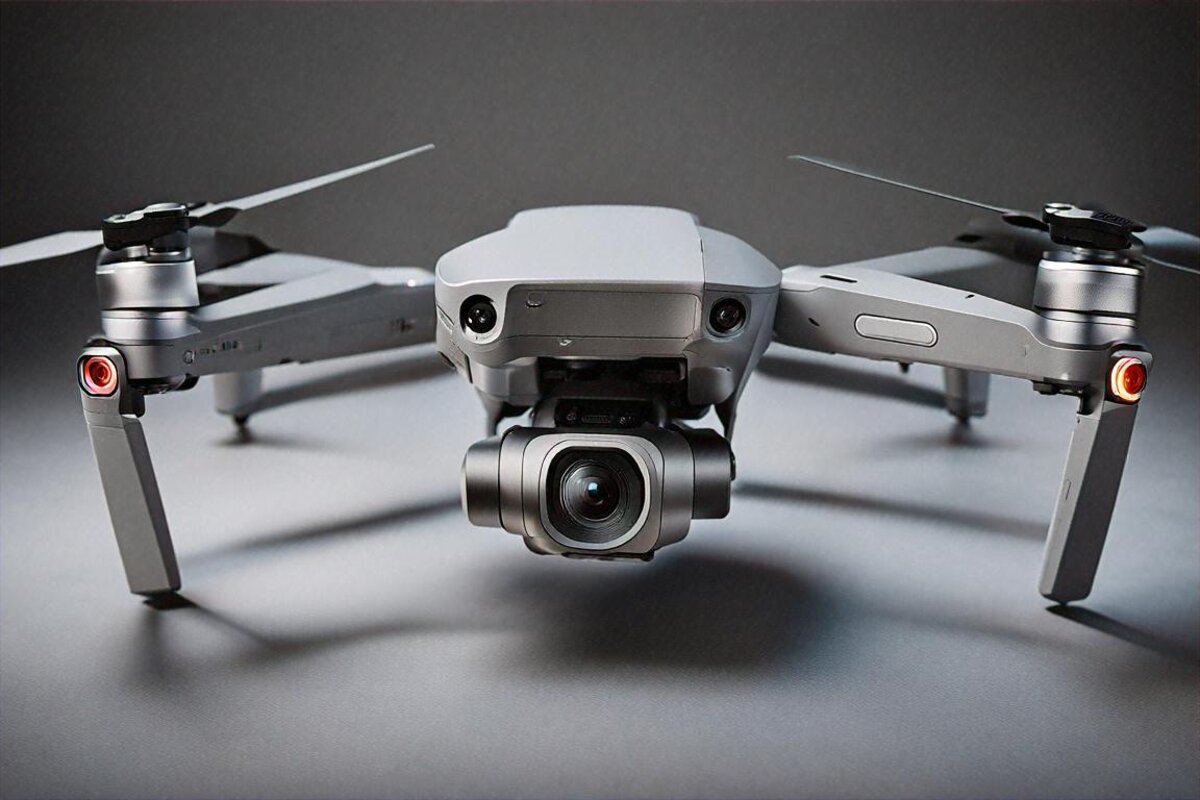
My friend Karthik called me last week. The guy’s been shooting aerials since the Phantom 3, so when he just said “They finally did it” and hung up, I knew something had landed. He’d already pre-ordered. I told him to breathe. Then I spent about three weeks with a review unit of the DJI Air 3S, and yeah, I get it now. A drone like this at Rs 89,999 shouldn’t exist. Four years ago this kind of capability ran you north of two lakhs.
I’ve flown maybe a dozen drones by now. Some were junk. A couple were genuinely brilliant. The Air 3S lives in this odd gap where it’s sold as mid-range but flies like it’s auditioning for the Mavic 3 Pro club. Not all the way there, and I’ll explain why, but close enough that most buyers won’t lose sleep over the difference. For Indian buyers who aren’t cinematographers but still want footage that looks expensive? Honestly, this might be the only drone worth your attention right now.
What’s actually in the box
The spec sheet reads a little absurd for the money, so let me walk through it. The main camera runs a 1-inch CMOS sensor. Fifty megapixels. f/1.8, 24mm equivalent. That’s your wide shooter, and it pulls in a genuinely silly amount of detail. Colors lean a touch warm straight out of camera, which I’m fine with — it flatters the golden-hour scenery most people are chasing anyway.
Then the second camera, which is the one that gets people. A 70mm medium telephoto, 1/1.3-inch sensor, 48 megapixels, f/2.8. Three times optical zoom. You can frame a subject from way off without the fish-eye smear you get when you crop into a wide shot. Wildlife, isolating a single building, tighter shots of people at an event — it unlocks compositions that just weren’t on the table for a sub-lakh drone before.
Video maxes out at 4K/120fps on the wide camera. Read that twice. 4K, 120 frames a second, on a 724-gram drone. Slow-mo aerial at this quality used to mean rigs that cost as much as a second-hand car. There’s also 1080p/240fps for extreme slow-mo, though the quality dip is obvious. Most days, 4K/60 with HDR on is the sweet spot. The 10-bit D-Log M profile leaves you decent room if you grade, and the 130 Mbps max bitrate means you’ve got plenty of data to push around in post.
You get 42 GB of internal storage. Sounds generous until 4K/120 starts chewing through it. Grab a V30 U3 microSD — DJI points you at Lexar or Kingston, up to 512 GB. On a weekend in Udaipur I burned through about 180 GB in two days. I was shooting loose, sure, but storage panic is a real feeling when you’re somewhere stunning and the card’s filling up.
The battery’s a 4,276 mAh Li-ion pack, 62.5 Wh. DJI says 45 minutes of flight and I’m a little skeptical, but I landed at 38-40 minutes in real conditions every time. Still ridiculous. Charging’s about 80 minutes off the bundled 65W brick, or roughly 60 with a 100W adapter. If you’re planning long shoots, the Fly More Combo and its spare batteries earns its keep — nothing ends a good session faster than sitting around waiting for a charge.
Weight is 724 grams. It folds. Slips into a messenger bag without a fight. Folded it’s about 214mm x 100mm x 89mm, smaller than plenty of water bottles. I’ve hauled it up to Triund and through the lanes of Varanasi and never resented carrying it. Build’s appropriate for the price too — no flex, no creak, the hinges feel solid, and it doesn’t seem like it’ll come apart if your bag takes a knock. Not the tank-grade feel of the Mavic 3 line, but you weren’t paying for that.
Positioning runs on GPS, Galileo, and BeiDou. Hover accuracy is plus or minus 0.1 meters vertically and 0.3 horizontally with vision positioning. What does that mean in the air? It parks itself and stays put. I had it hovering over Marine Drive in Mumbai with the wind kicking up and it barely twitched. Max wind resistance is rated at 12 m/s, and while I wouldn’t lean on that ceiling, it shrugged off coastal gusts.
Now obstacle avoidance, because DJI went a bit mad here, in the good way. The Air 3S sees in every direction — forward, back, sideways, up, down. Forward detection runs a dedicated LiDAR sensor good to 25 meters. Three pairs of vision sensors. A downward infrared ToF for good measure.
Here’s what all that jargon adds up to: it works. I aimed this thing at trees, walls, and my own car on purpose. Every time, it stopped or steered around. Forward sensing spots obstacles up to 200 meters out for planning ahead, while active avoidance kicks in between 0.5 and 18 meters. I flew it between banyans in a Bangalore park and it threaded gaps I’d never have risked by hand.
Nightscape omnidirectional sensing is DJI’s term for the system holding up in low light. I ran it through dusk shoots and it didn’t stumble. Go full dark and it gets shakier, obviously, but at blue hour — when most people are actually flying — no problems. For a klutz who once buried a Mini 2 in a palm tree, that safety net isn’t a luxury. It’s the reason I can actually relax up there.
Transmission is DJI’s O4 system. 1080p/60fps live feed. Range is rated at 20 km under FCC rules, though here in India you’re realistically looking at maybe 10 km with SRRC limits. I’ve never needed a fraction of that — flying legally in India means keeping it within sight anyway. Signal strength is where O4 really earns it. In messy city RF, the feed stayed clean and quick. Latency sits near 120 milliseconds. Six antennas, 2T4R setup. You won’t drop the link unless you’re doing something you really shouldn’t.
The gimbal’s a proper 3-axis mechanical job — tilt, roll, pan. Angular vibration is rated at plus or minus 0.0037 degrees, which is absurd precision. Tilt runs from negative 135 to positive 70 degrees, so you can aim straight up for those looking-at-the-sky shots. Footage comes out buttery. Mechanically stabilized video has a quality that electronic stabilization can’t fake, and the Air 3S nails it every time.
Smart RTH — Return to Home — now remembers the path it took out. Brilliant when there’s stuff in the way. Rather than barreling straight back at you and maybe clipping a branch, it retraces its route. I’d argue it’s the most underrated thing here. You can fly hard into a complicated spot knowing the drone can find its own way home.
The DJI RC-N3 in the standard kit is fine, not thrilling. Battery runs about 3.5 hours if you’re not charging your phone off it, dropping to 1.5 if you are. It’s 320 grams, charges in roughly 2 hours. Sticks feel good, the layout’s obvious if you’ve touched any DJI gear, and the mount grips my Galaxy S24 Ultra without complaint. But — and this is me nitpicking — I wish the RC 2 with its built-in screen shipped in the base kit at this price. The Fly More Combo has it, fine, but a Rs 89,999 box should probably include the better controller.
Photo modes cover single shot, burst at 3, 5, or 7 frames, AEB for HDR work, and timed shots. ISO climbs to 6400 at 12 megapixels and 3200 at the full 50 MP. Shutter runs 1/8000 to 2 seconds on the wide, 1/16000 to 2 seconds on the tele. These aren’t “good for a drone” numbers. They’re the kind of specs you’d see on a respectable mirrorless body.
Free Panorama mode shoots vertical 9:16 at up to 2.7K/60fps. Aimed squarely at the Reels and Shorts crowd, and a smart call by DJI. Subject Focusing keeps your target crisp while the background drops away, which sings with the telephoto. Digital zoom goes to 2.9x on the wide and 9x on the tele, though anything past 5-6x turns mushy.
I put it through three very different places. First Udaipur, flying over the lakes at sunrise. The 1-inch sensor caught the reflections with a richness that made me stop and just watch the playback. Smooth sky gradients, zero banding, and the dynamic range held the bright sky against the darker water without me touching exposure comp. Second was a coastal stretch near Gokarna — wind, salt air, the sort of place that makes me twitchy with pricey gear. The Air 3S took the crosswinds calmly, and the tele was perfect for picking out fishing boats from a distance. Third was farmland outside Pune, deliberately flat and dull, to see whether the camera could find something interesting in a boring patch of ground. The answer: the telephoto bails you out. Compressing perspective from above genuinely changes what flat looks like.
One thing nags at me, and I might be in the minority — the app. DJI Fly runs fine. It’s stable, it does the job. But the interface feels busy for newcomers. So many settings, so many options stashed in submenus, that a first-time pilot could feel buried. DJI’s clearly building for enthusiasts and prosumers here, which tracks, but a stripped-down beginner mode would help.
Against the competition — and there really isn’t much at this tier — the Air 3S walks it. The Autel EVO Lite+ is the nearest thing and it’s behind on flight feel and camera quality. The DJI Mini 4 Pro is lighter and cheaper, but the sensor’s smaller and you lose the telephoto completely. Stepping up from a Mini? The Air 3S is the obvious next buy. Torn between this and the Mavic 3 Classic? Keep your money unless you genuinely need the Hasselblad color science. The Air 3S gets you 85 percent of the way for a lot less cash.
Indian rules matter because they shape how you’ll actually use it. At 724 grams the Air 3S sits in the micro category under DGCA. You’ll register it on DigitalSky and pull a UIN. Flying’s off-limits in certain zones — airports, military sites, the usual list. Ceiling is 120 meters AGL. Learn the airspace map in the DJI app; it’ll stop you wandering somewhere you shouldn’t be. The upside: micro drones don’t need a remote pilot license, so the barrier to entry is far lower than it once was.
At Rs 89,999 for the standard kit, this isn’t an impulse buy. But weigh it up. A decent mirrorless with a telephoto runs well past a lakh. A GoPro with an ND kit is around 50k and gives you no aerial capability at all. The Air 3S hands you two cameras, the view from above, near-45-minute flights, cinema-grade video, and obstacle avoidance that protects your money. Around Diwali and Big Billion Day I’ve watched DJI gear drop 10-15 percent on Amazon and Flipkart. Wait for a deal and you might land the Fly More Combo for roughly what the standard kit costs now.
Speed, since I haven’t said it: 21 m/s normally, 27 m/s with a tailwind behind you. Operating range is minus 10 to 40 degrees Celsius, which covers everything from a Kashmir winter to a Chennai summer. Max flight distance is 32 km and max takeoff altitude is 6,000 meters — numbers you’ll never go near, but it’s nice knowing the headroom’s there.
I keep circling back to the telephoto. That’s the thing that pulls this drone away from everything else under a lakh. You can find cheaper drones with good wide cameras. You can hunt down longer flight times if you try. But swapping between 24mm and 70mm in the air, with both lenses actually being good? That’s the Air 3S’s whole pitch. Karthik was right. They finally did it.
Specifications
- Weight: 724 g
- Main Camera: 1-inch CMOS, 50MP, f/1.8, 24mm equivalent
- Telephoto Camera: 1/1.3-inch CMOS, 48MP, f/2.8, 70mm equivalent
- Video: 4K/120fps, 1080p/240fps, 10-bit D-Log M, 130 Mbps max bitrate
- Flight Time: Up to 45 minutes (38-40 real-world)
- Battery: 4,276 mAh / 62.5 Wh Li-ion
- Obstacle Sensing: Omnidirectional with forward LiDAR
- Transmission: DJI O4, 1080p/60fps, 20 km range (FCC)
- Storage: 42 GB internal + microSD up to 512 GB
- GNSS: GPS + Galileo + BeiDou
- Gimbal: 3-axis mechanical stabilization
- Charging: ~80 min (65W) / ~60 min (100W)
- Max Speed: 21 m/s (27 m/s with tailwind)
- Folded Size: 214 x 100 x 89 mm
- Operating Temp: -10 to 40 degrees C
- Price: Rs 89,999
What I Liked
- Dual camera system with genuine optical zoom — the 70mm telephoto changes how you shoot from the air
- 1-inch main sensor captures rich, detailed images with impressive dynamic range up to 14 stops
- 45-minute flight time claim is nearly accurate — 38-40 minutes in real conditions is outstanding
- Omnidirectional obstacle sensing with LiDAR actually works reliably, even in low light
- 4K/120fps slow-motion aerial footage at this price is unmatched in the segment
- Smart RTH path memorization makes complex environments much safer to fly in
- Folds small enough to carry in a regular messenger bag without a dedicated drone case
- O4 transmission stays rock solid even in congested city RF environments
What Could Be Better
- Standard kit should include the RC 2 controller with built-in screen at this price
- 42 GB internal storage fills up fast at 4K/120 — a microSD card is basically mandatory
- DJI Fly app interface feels cluttered and overwhelming for first-time drone users
- Digital zoom past 5-6x produces noticeably soft results on both cameras
- Telephoto camera f/2.8 aperture limits its low-light performance compared to the main lens
Rating: 9/10
For Rs 89,999 you get two cameras, flight times that border on absurd, obstacle avoidance you can trust, and video that punches well above its weight class. It’s not flawless — the app needs a rethink and the base controller’s a notch below where it ought to be — but this is the drone I’d point almost anyone in India toward once they’re ready to spend real money on aerial work.
Full Specifications
| Weight | 724 g |
|---|---|
| Main Camera | 1-inch CMOS, 50MP, f/1.8, 24mm equivalent |
| Telephoto Camera | 1/1.3-inch CMOS, 48MP, f/2.8, 70mm equivalent |
| Video | 4K/120fps, 1080p/240fps, 10-bit D-Log M, 130 Mbps max bitrate |
| Flight Time | Up to 45 minutes (38-40 real-world) |
| Battery | 4,276 mAh / 62.5 Wh Li-ion |
| Obstacle Sensing | Omnidirectional with forward LiDAR |
| Transmission | DJI O4, 1080p/60fps, 20 km range (FCC) |
| Storage | 42 GB internal + microSD up to 512 GB |
| GNSS | GPS + Galileo + BeiDou |
| Gimbal | 3-axis mechanical stabilization |
| Charging | ~80 min (65W) / ~60 min (100W) |
| Max Speed | 21 m/s (27 m/s with tailwind) |
| Folded Size | 214 x 100 x 89 mm |
| Operating Temp | -10 to 40 degrees C |
| Price | Rs 89,999 |
Pros
- Dual camera system with genuine optical zoom — the 70mm telephoto changes how you shoot from the air
- 1-inch main sensor captures rich, detailed images with impressive dynamic range up to 14 stops
- 45-minute flight time claim is nearly accurate — 38-40 minutes in real conditions is outstanding
- Omnidirectional obstacle sensing with LiDAR actually works reliably, even in low light
- 4K/120fps slow-motion aerial footage at this price is unmatched in the segment
- Smart RTH path memorization makes complex environments much safer to fly in
- Folds small enough to carry in a regular messenger bag without a dedicated drone case
- O4 transmission stays rock solid even in congested city RF environments
Cons
- Standard kit should include the RC 2 controller with built-in screen at this price
- 42 GB internal storage fills up fast at 4K/120 — a microSD card is basically mandatory
- DJI Fly app interface feels cluttered and overwhelming for first-time drone users
- Digital zoom past 5-6x produces noticeably soft results on both cameras
- Telephoto camera f/2.8 aperture limits its low-light performance compared to the main lens
Our Rating: 9/10 · Price: ₹89,999


0 Comments