
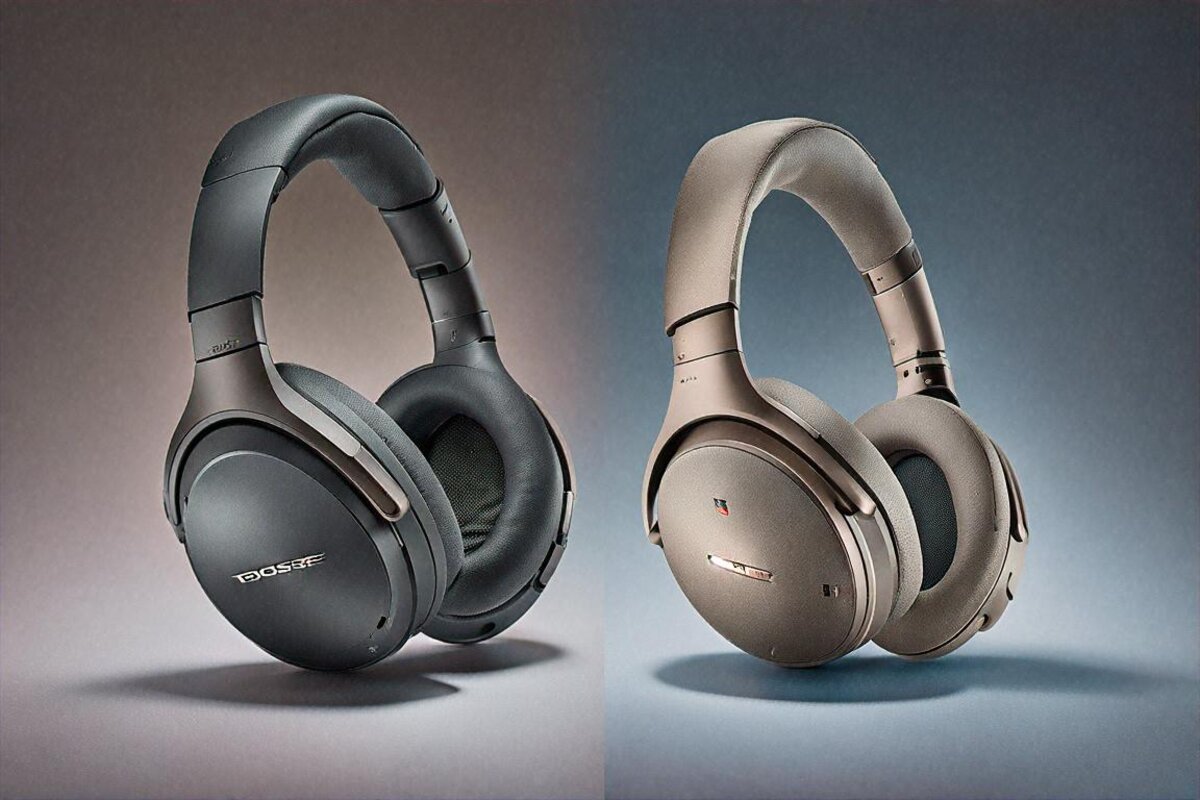
The XM6 wins on paper. Every spec, every number. That’s not why I sat down to write this.
For about three weeks now I’ve been swapping between the Sony WH-1000XM6 and the Bose QuietComfort 45 — Delhi Metro commutes, a couple of domestic flights, late-night coding sessions in a Bengaluru co-working space where somebody’s always on a speakerphone call. What I keep running into is this: the spec-sheet winner and the daily-use winner aren’t always the same pair. Sometimes they are. Most of the time, actually. But not always, and that gap is exactly what makes this comparison worth doing.
Both live in the ₹25,000-30,000 band here. The WH-1000XM6 sells for ₹29,990, the QC45 for ₹26,900. That ₹3,090 difference either matters or it doesn’t, depending on what you’re chasing — and I’ll get there.
Specifications Comparison
| Feature | Sony WH-1000XM6 | Bose QuietComfort 45 |
|---|---|---|
| Driver | 30mm carbon fiber | 35mm TriPort |
| ANC | Dual Processor V2 | Acoustic Noise Cancelling |
| Battery | 40 hours (ANC on) | 24 hours (ANC on) |
| Quick Charge | 3 min = 3 hours | 15 min = 2.5 hours |
| Codec | LDAC, AAC, SBC, LC3 | AAC, SBC |
| Multipoint | Yes (3 devices) | Yes (2 devices) |
| Weight | 250g | 240g |
| Price in India | ₹29,990 | ₹26,900 |
Noise Cancellation
Start where everyone starts: noise cancellation. Sony’s Dual Processor V2 is better. I don’t think there’s a serious case against that anymore. Strap on the XM6 in a Delhi auto-rickshaw — two-stroke engine, horns from every angle, that one guy blasting devotional music off his phone speaker — and the world just recedes. Not all the way, mind you. No ANC headphone on earth fully kills the chaos of Chandni Chowk at noon. But the XM6 gets you maybe 85% there, which feels nearly unreal when you’re used to hearing the lot.
What Sony’s done with the adaptive processing genuinely impresses me. The XM6 reads your surroundings and adjusts on the fly. Walk from a loud street into a quiet cafe and the profile shifts inside a second or two, no buttons pressed. Speak-to-Chat kicks in the moment you open your mouth — music pauses, your voice goes through, everything resumes when you stop. Handy for those chai-break interruptions when a colleague wanders over about a deadline.
Bose’s Acoustic Noise Cancelling on the QC45 is good. I want that clear. If you’d never tried the XM6, you’d probably swear the QC45’s ANC was the best you’d ever worn. Low-frequency stuff — airplane drone, the hum of an AC, the steady rumble of a train — it handles with an ease that’s almost casual. There’s a thin argument that the QC45 edges the Sony on very specific low frequencies. Airplane cabin noise, say. A Bengaluru-Delhi IndiGo flight felt maybe a touch quieter on the Bose than the Sony, though I’d hedge that hard since I wasn’t measuring with instruments.
Where the Sony clearly pulls ahead is mid-to-high frequency cancellation. Voices, keyboard clatter, that auto-rickshaw horn again. Indian cities throw a wall of mid-range noise at you, and the XM6’s Dual Processor V2 swallows it in a way the QC45 can’t quite manage. If you’re buying ANC mainly for Indian city life — and most people reading this are — the Sony is the stronger pick on cancellation alone.
Neither one beats wind noise cleanly, by the way. Standing on a Gurgaon flyover waiting for an Uber in 30 km/h gusts, both struggled. Sony coped a bit better, but I wouldn’t call either great in heavy wind. Worth saying, since two-wheeler commuters ask about this.
Sound Quality
Sound quality is where personal taste starts muddying the water, and I’ll be upfront about that rather than pretend there’s one correct answer.
The WH-1000XM6 leans into detail and energy. Bass is deep and punchy without going muddy — Bollywood tracks with heavy low-end, a Pritam composition say, land with real weight. Highs are crisp. Vocals sit forward in the mix, which is brilliant for playback singers but can get a little fatiguing over very long sessions if you’re treble-sensitive. Instrument separation is excellent. Put on something busy — a Shankar-Ehsaan-Loy arrangement, or some well-produced Western classical — and you can pick out individual instruments without straining.
The Sony’s other big lead over the Bose is codec support. LDAC, AAC, SBC, and LC3. On an Android phone (and statistically most of you are — Android runs India), LDAC gives you near-lossless Bluetooth audio. That’s 990 kbps of throughput against AAC’s roughly 256 kbps. You can hear it. I won’t claim it’s night and day, but on well-mastered tracks through Apple Music or Amazon Music HD, the LDAC edge is real. Little details surface — the room ambience on a live cut, the breath before a vocal line, the decay of a tabla stroke. Stuff that gets smoothed flat at lower bitrates.
The QC45’s sound is warmer. People call it more “musical,” and I sort of see why, though that word always struck me as a bit fuzzy. Bass is present and rounded but doesn’t dig as deep as the Sony’s. Mids are smooth and easy — probably kinder over an eight-hour workday. Treble is pulled back a touch, which means less fatigue but also less sparkle on hi-hats and strings.
The real catch for the Bose on sound is the codec limit. You’re stuck with AAC and SBC. iPhone users won’t blink, since iOS doesn’t do LDAC anyway. But Android users — again, most of the Indian market — are leaving quality on the table. It’s not that the QC45 sounds bad over AAC. It sounds good. It just doesn’t sound as good as it could if Bose had put LDAC in, and the Sony reminds you of that every time you switch.
For Indian classical specifically — sitar, sarod, flute, vocals over a tanpura drone — I slightly preferred the Sony’s detail retrieval. Sustain on strings came through cleaner. Carnatic vocals benefited from that forward midrange. Hindustani instrumental pieces felt more spatial. Your mileage may vary, though. Anyone who finds the Sony’s treble too bright could easily prefer the Bose’s smoother take, and I wouldn’t call them wrong.
Comfort & Build
Comfort’s the one area where I’d hand a real edge to the Bose, even though the XM6 has closed the gap.
Sony reworked the earcups this generation with softer protein leather, and it’s a genuine step up from the XM5. The headband spreads weight well across the top of your head, and the clamping force is moderate — firm enough to stay put during a head-bobbing session, not so tight you get a pressure headache after two hours. At 250g it’s light for a full-size ANC can.
The QC45 at 240g is ten grams lighter. Doesn’t sound like much, and honestly you can’t feel it in the hand. But Bose has been doing comfort longer than anyone, and it shows in the small things. The ear cushions are plush enough that you half forget you’re wearing anything. They breathe a bit better in humid heat too — which matters in India from April through September, when even air-conditioned rooms can turn sticky. I wore both through a 40-degree Delhi afternoon in a semi-outdoor co-working space, and the Bose was noticeably less sweaty.
Build on both is excellent. The Sony feels more premium with its matte finish and smooth folding mechanism. The Bose is plainer, maybe a shade more plasticky, but it’s proven durable across several generations. Neither feels like it’ll fall apart any time soon.
Portability is roughly a wash. Both fold flat, both ship with decent cases. Sony’s case is a little more compact. Not a dealbreaker either way.
Battery Life
Forty hours against twenty-four. That’s the headline, and honestly it tells most of the story.
Sony’s 40-hour figure with ANC on is absurd. I charged the XM6 on a Sunday evening and didn’t plug it in again until the following Friday. Five days of mixed use, maybe four or five hours a day between commuting, working, and evening listening. A Delhi-to-Kolkata Rajdhani Express runs 17-plus hours; the XM6 will outlast the whole trip and still have charge for the auto ride home from Howrah. The Bose would need a top-up somewhere around Allahabad.
Quick charging tells an even better story. Sony’s 3-minute burst gives you 3 hours of playback. Three minutes. That’s how long it takes to brush your teeth. Bose needs 15 minutes for 2.5 hours, which is still fine but not in the same league when you’re scrambling before a flight boards.
In practice the Sony’s battery edge means you simply think about charging less. Sounds minor, but anyone who’s had a headphone die mid-journey on a long train through rural India — where the power outlets are either taken or broken — knows the value of just not worrying about it. I reached for the Sony more often partly for this alone. The “is this charged enough?” tax just doesn’t exist with the XM6.
With ANC off, Sony claims around 50 hours and Bose pushes toward 30. I didn’t fully run those down, but my partial tests put them in the right ballpark.
Multipoint & Connectivity
Both support multipoint Bluetooth, so you stay connected to phone and laptop at once. Pretty important for work-from-home setups where you bounce between a Zoom call on the laptop and a WhatsApp call on the phone without re-pairing.
Sony goes further with 3-device multipoint. Phone, laptop, and tablet, all live together. I ran it with a Samsung Galaxy S25, a MacBook, and an iPad Mini, and switching sources worked smoothly maybe 90% of the time. The other 10% wanted a manual nudge in the Sony Headphones Connect app, but that’s a minor gripe.
Bose tops out at 2-device multipoint. For most people that’s plenty — phone and laptop cover the main case. But if you’ve got three devices in rotation, the Sony has the edge.
Bluetooth was rock-steady on both across Delhi, Mumbai, and Bengaluru in my testing. No dropouts in packed metro stations, which is where cheap earbuds sometimes choke on interference from dozens of nearby devices.
Call Quality & Microphone
I should flag call quality, because plenty of people use these for work calls, and it’s one area where the Bose holds its own or arguably nudges ahead.
The QC45’s mic system handles voice isolation well on calls. Background noise gets filtered cleanly, and my voice came through clear enough that colleagues didn’t twig I was calling from a busy Starbucks in Connaught Place. Sony’s call quality is good too — better than the XM5 — but in really noisy spots I caught callers occasionally asking me to repeat myself on the XM6, not on the QC45.
It’s a small thing. And Sony’s improving it each generation. But for anyone spending 3-4 hours a day on Teams or Google Meet — and plenty of Indian IT professionals do — the Bose’s slight mic advantage might genuinely tip the decision.
App Experience & Features
Sony’s Headphones Connect app is feature-rich to the point of overload. Tweak the EQ in fine detail, dial ANC levels, set activity profiles (commuting, sitting, walking), adjust Speak-to-Chat sensitivity, switch on DSEE Extreme to upscale compressed audio — the list runs on. If you like to tinker, you’ll happily lose an hour getting everything just so. If you just want to pair and listen, the defaults are honestly pretty good out of the box.
The Bose Music app is simpler. Not much EQ — a basic slider rather than a parametric equaliser. ANC toggles between full, aware, and off. Less to fiddle with overall, but the flip side is it’s quicker to set up and you don’t get lost in menus. Some people prefer that, and there’s real wisdom in it.
One thing I’d flag: Sony’s app can be buggy on certain Android phones. It crashed on me a couple of times on a Pixel 8 during testing, though it ran fine on a Samsung Galaxy S25 Ultra. Bose’s app was stable throughout. Not a big deal on its own, but if your luck with Sony’s app is bad, it can sour the whole experience, since some features only live inside the app.
Indian Pricing & Value
At ₹29,990 for the Sony WH-1000XM6 and ₹26,900 for the Bose QC45, you’re spending serious money either way. For perspective, ₹26,900-29,990 is more than a lot of Indians spend on a phone. Neither is an impulse buy.
During sale season — Flipkart Big Billion Days, Amazon Great Indian Festival — both usually drop ₹3,000-5,000. Sony has fallen to around ₹25,000-26,000 in past sales, the Bose to around ₹22,000-23,000. If you can wait for a sale, the value equation gets better for both, but especially the Bose, which starts to look like a steal at ₹22,000.
Bank offers and card EMI are available on both through Flipkart and Amazon India. No-cost EMI over 3-6 months makes either easier to stomach if you’re budget-conscious but don’t want to skimp on audio.
On pure value, here’s how I’d frame it: Sony gives you more for the money spent (better ANC, better battery, better codecs, more multipoint devices), while the Bose hands you 80-85% of the experience for ₹3,000 less. Whether that last 15-20% is worth three thousand rupees comes down entirely to your priorities.
Durability & Long-Term Ownership
Both should last at least 3-4 years with regular use. The earpads will probably need replacing after 18-24 months of daily wear in Indian conditions — sweat, humidity, and dust grind down any cushion material. Replacement pads are on Amazon India for both, usually ₹800-1,500 for decent third-party options.
Software support is where Sony tends to push harder. The XM5 kept getting meaningful firmware updates more than two years after launch, and I’d expect the XM6 to follow suit. Bose updates too, but less often and usually for bug fixes rather than new features.
One durability note: Sony’s touch-sensitive earcup controls can fire accidentally if you set the headphone down carelessly on a surface. Mildly irritating. Bose uses physical buttons, which sidestep that. Minor, but worth a mention, because it’s one of those daily friction points specs never capture.
Verdict
Buy the Sony WH-1000XM6 if: you want the best ANC for Indian environments, you’re an Android user who cares about audio quality (LDAC makes a real difference), you travel often and need that 40-hour battery, or you want 3-device multipoint. At ₹29,990 it’s the better headphone by most measurable yardsticks. The pick for frequent travellers, Android audiophiles, and anyone who values never thinking about battery life.
Buy the Bose QC45 if: comfort is your top priority and you’ll wear these 6-8 hours a day, you spend most of your day on work calls and want slightly better mic quality, you’re an iPhone user (the codec edge disappears since iOS doesn’t do LDAC), or you want to save ₹3,000 and still get a genuinely excellent ANC headphone. Also the better call if you prefer a warmer, less fatiguing sound for long listening.
For most Indian buyers after the best all-round ANC headphone in 2026, the Sony WH-1000XM6 is the one to get. That 40-hour battery paired with cancellation tuned for the noise India actually throws at you — horns, crowds, construction, train rumble — makes it hard to argue against. The Bose QC45 is what you buy when you know exactly why you want it over the Sony, and that’s a perfectly valid place to land.
Our Rating: 9.1/10 · Price: ₹29,990
0 Comments