
Delhi’s AQI Touched 462 Last November. That’s When I Quit Arguing and Started Buying.
Four hundred and sixty-two. That was the PM2.5 outside my flat in Dwarka last November. For scale, the WHO calls anything over 15 unhealthy. My three-year-old had been coughing for a fortnight straight. The pediatrician put it down to pollution, prescribed a nebuliser, and told us to “try to keep indoor air clean.” As though that hadn’t crossed our minds.
I’d dodged buying an air purifier for three years. Always some reason. Too dear. Not convinced they work. Can’t square the running costs. My partner kept asking. I kept saying “next month.” Then my kid coughed until he was sick, and next month turned into today.
The Xiaomi Smart Air Purifier 5 has been running in our living room for about four months. I’m going to give you all of it — what the readings actually did before and after, what caught me out, where it falls short, and who I reckon should buy this versus who’s throwing money away. Because at ₹14,999 it isn’t cheap. But after another Delhi winter with a toddler, I’m honestly not sure how we managed without one.
Why I Landed on Xiaomi
Start researching air purifiers in India and you drown quickly. Dyson wants ₹40,000 and up. Philips sits in the ₹20,000 to 25,000 band. There are no-name Chinese units on Amazon at ₹5,000 that look like they’d shed parts inside a month. Then there’s Xiaomi at ₹14,999, with numbers that on paper match or beat purifiers costing twice as much.
600 m3/h CADR — Clean Air Delivery Rate, basically how much air it churns through an hour. In plain terms, that’s rated for rooms up to 130 square metres. My living room runs about 70, so I’ve got room to spare. A true HEPA H13 filter catching 99.97% of particles down to 0.3 microns. An activated carbon layer for odours and VOCs. Smart control through the Mi Home app plus Google Home and Alexa.
Those specs at that money made the call easy. I’m sure the Dyson is built nicer and the Philips might run longer, but I wasn’t about to spend double when the filtration tech underneath is essentially the same.
Design: White Cylinder, Surprisingly Easy on the Eye
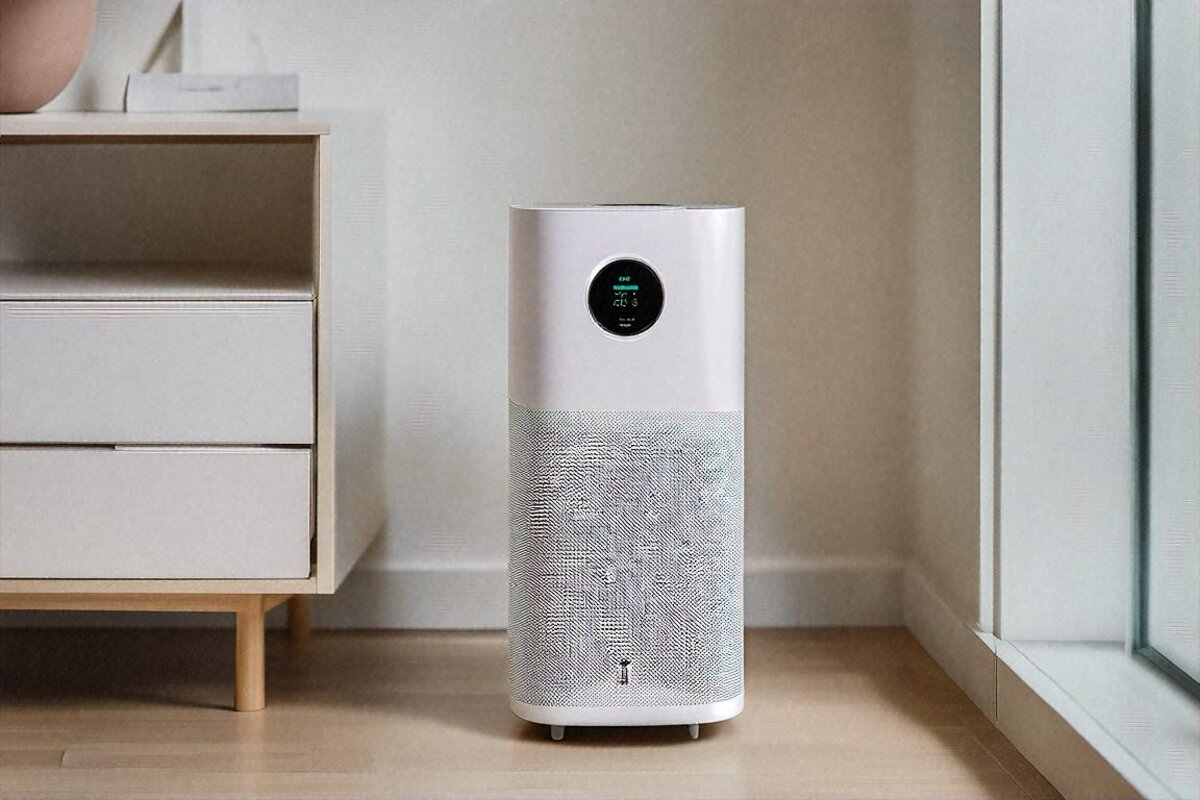
It’s a white cylinder. There, design covered. Xiaomi didn’t strain to make it pretty, but they did keep it neutral enough that my partner didn’t veto it sitting in the living room. Counts as a win in my book.
The cylindrical shape pulls its weight, actually — 360-degree intake draws air from every side at once, which beats flat-backed units that have to stand off a wall with clearance behind. Ours sits about 30 centimetres out and runs fine.
Up front there’s an OLED panel showing live PM2.5, fan speed and remaining filter life. You can read it from across the room, which matters more than you’d guess. Glancing over and seeing “PM2.5: 12” when it was 180 outside that morning is genuinely calming. A little psychological comfort baked into the hardware.
Build quality is… fine. It’s plastic. Solid plastic, to be fair — no rattles when it runs, tight panel gaps, the filter door on the bottom swings open and shut cleanly. Not premium the way a Dyson feels premium. But it feels like it’ll last. Nothing about it screams “this dies in a year.” Four months in it still looks basically new, though the white does show dust, which is a touch ironic for an air purifier.
The Numbers Don’t Lie: What Happened to Our Air
Here’s the part I care about most, and probably the part you do too. Does it actually work? Let me hand you real numbers from my own use, because vague talk of “cleaner air” helps no one.
Our living room in Dwarka. Roughly 70 square metres. Peak winter pollution, November into December. Outdoor AQI regularly 300 to 460. Every window and door shut.
First test. Room starting at an indoor PM2.5 of 180, which matched outside after I’d cracked the windows for ventilation earlier. I set it to Turbo. Within 45 minutes indoor PM2.5 dropped under 20. Under twenty. From 180 to under 20 in forty-five minutes. I checked the sensor three times, certain it was on the blink. It wasn’t.
In Auto, which is how it runs 90% of the time, the purifier sets fan speed off live sensor readings. Someone opens the front door and outdoor muck pours in — fan ramps up within seconds. Wife starts frying with the kitchen door open and the oil starts smoking — fan climbs. Shut the doors and the source goes — fan eases off and goes quiet. It’s responsive, and it genuinely seems to read the room it’s working.
The HEPA H13 catches more than PM2.5. Pollen, dust mites, pet dander, all common in Indian homes, especially at season change when everyone’s sneezing. My son’s nagging cough cleared up within about ten days of running it steadily. I can’t pin causation there — his doctor would call it correlation — but the timing was hard to wave off.
The activated carbon layer goes after odours, formaldehyde and volatile organic compounds. Cooking smells clear noticeably faster with it on. My partner does plenty of deep frying — puris, pakoras, samosas — and the oil smell used to hang in the living room for hours. With the purifier? Maybe twenty or thirty minutes. Not gone entirely. But cut right down.
The App and Smart Features
The Mi Home app talks to the purifier over Wi-Fi for remote control, live monitoring and automation. I can check indoor air from the office. Switch it on half an hour before I get home so the air’s already clean when I walk in. Set schedules — it runs high from 6 AM to 8 AM when my partner opens the windows for morning air (which, in winter, means letting the pollution straight in), drops to Auto for the day, then shifts to Sleep at 11 PM.
Google Home and Alexa support means voice control works. “Hey Google, set the air purifier to turbo” fires off my Nest speaker. Not that I use voice much for this — it’s not like a light you’re forever flipping. Set the automation and mostly forget it.
The historical logging in the Mi Home app is something I never expected to lean on and absolutely do. Over four months I can see the pollution patterns in my own home. Cooking spikes around lunch and dinner. Early-morning spikes when the windows open. Weekend spikes when we clean and the dust kicks up. Diwali week was… a chart shaped like a mountain range. That data actually nudged a couple of habits — we now air the place out in early afternoon, when outdoor AQI tends to bottom out, instead of first thing when it’s worst.
One thing: the app needs a Mi account, so that’s yet another login for yet another Chinese tech firm’s ecosystem. I know some people have qualms about that. I’ve made my peace, but it’s worth saying.
Noise: The Sleep Mode Question
This one matters a lot if you’re eyeing one for a bedroom, which plenty of people in India probably are, since bedrooms are often where the kids sleep and so where you most want clean air.
At 26 dB in Sleep mode, the Xiaomi Air Purifier 5 is genuinely quiet. White-noise quiet. I-actually-sleep-better-with-it-on quiet. My son’s room runs it on Sleep all night and nobody stirs because of it. A gentle hum that melts into the background within minutes.
Turbo is another story. Sixty-five decibels. That’s about the level of normal conversation. Not unbearable for daytime living room use. But you’ll notice it, and you wouldn’t want the TV on or a phone call going with it roaring on Turbo right beside you. I tend to run Turbo to knock PM2.5 down fast, then hand off to Auto once levels are manageable. Works as a pattern.
Auto sits between the two, sliding between near-silent and medium speeds. Most of the time it’s quiet enough that I forget it’s on. Now and then it’ll surge when it picks up a spike, and the sudden jump in sound startles me for a beat before I remember what it’s doing.
Filter Life and Running Costs — the Hidden Bill
Let’s get into the thing every air purifier review ought to cover and half of them skip. The purchase price is ₹14,999. That’s the one-off. The ongoing cost is the filter.
Xiaomi rates it at 6 to 12 months depending on use and local air. In Delhi, through winter, where outdoor AQI routinely lands in “very poor” to “severe,” I’d bet the low end. My filter health dropped from 100% to about 40% across four months of near-constant running. Extrapolate and I’m looking at a swap every 5 to 6 months in heavy season, maybe 8 to 10 in the calmer summer stretch.
Replacement filters run about ₹2,500 each on Amazon and Mi.com. So the annual running cost lands somewhere between ₹2,500 and ₹5,000, depending where you live and how foul the air gets. Delhi residents, budget for two a year minimum. That’s ₹5,000 a year on top of the buy price. Not nothing, but not outrageous either — my partner spends more than that a month on the kids’ vitamin supplements.
Power draw maxes at 65W, and on Auto in practice it runs well under that. My electricity bill hasn’t shifted in any way I can spot since the purifier arrived. Pennies a day, basically.
Specifications
| Specification | Details |
|---|---|
| CADR | 600 m3/h |
| Coverage | 130 sqm |
| Filter | True HEPA H13 + Activated Carbon |
| PM2.5 Sensor | Real-time laser particle |
| Noise | 26dB sleep mode, 65dB turbo |
| Smart | Mi Home, Google Home, Alexa |
| Power | 65W |
Pros
- 600 m3/h CADR — excellent coverage for Indian homes
- HEPA H13 removes 99.97% of particles
- Real-time PM2.5 monitoring and auto mode
- Mi Home smart automation capabilities
- 26dB sleep mode genuinely quiet
Cons
- Filter replacement cost adds to long-term expense
- Not suitable for very large open-plan spaces above 130 sqm
- Turbo mode at 65dB is loud
- App requires Mi account
Who Is This NOT For?
Before I tell you to buy it, let me tell you who shouldn’t. Live in a city with reliably good air — parts of South India, certain hill stations, coastal pockets — and you probably don’t need a purifier at all, never mind this one. Keep your money.
Got a very large open-plan space above 130 square metres? A single unit won’t cover it. You’d want two, or you’d step up to a higher-CADR model. Xiaomi does make bigger units, but now you’re into a different budget.
Expecting a purifier to fix every respiratory problem? Temper that. It helps. It really does. My son’s cough eased dramatically. But it’s not a medical device and won’t cure asthma or allergies by itself. It’s one piece of a bigger approach — windows sealed during peak pollution, the kitchen exhaust used properly, and no burning incense in a closed room (sorry, Mum).
Seasonal Buying Advice — When to Actually Get One
Here’s my honest steer, and one most brands would rather I kept quiet. Don’t buy an air purifier in November. I know that’s when the urgency hits — eyes stinging, sky grey, every news channel flashing AQI maps in angry red. But November is also when prices peak and stock runs dry. Everyone panics and buys at once.
Buy in August or September. Prices tend to sit lower. Stock’s plentiful. You’ve got time to set it up, test it, work out your routines and automation, and swap any filters before the bad season lands. I bought mine mid-October and paid the full ₹14,999. My colleague held off till January and got it for ₹12,999 in a sale. That one stung a little.
If you’re reading this in winter and your kid’s already coughing — obviously, don’t wait. Buy it now. The health upside beats a couple thousand rupees in savings. But if you’re reading this in summer, thinking ahead? September. Put it in the calendar.
For cities that aren’t Delhi — Mumbai, Bangalore, Hyderabad — you probably want it October through February, with spikes around Diwali and New Year. Some months Auto will barely kick in because the indoor air’s already fine. That’s okay. Those are the months your filter stretches further, balancing out the winter when it’s working overtime.
For Delhi NCR? Run it all year. I’m not joking. Summer AQI in Delhi still hits 100 to 150 on a bad day. That’s still unhealthy by WHO standards. Leave it on Auto and let the sensor decide when to graft and when to rest. The 65W draw on Auto barely registers on the bill.
Four Months In — Was It Worth ₹14,999?
My son stopped coughing. That alone settled it. Everything else — the live monitoring, the app automation, the room that smells noticeably fresher, the comfort of knowing you’re breathing filtered air — all of that’s a bonus.
I’d call the Xiaomi Smart Air Purifier 5 the best value air purifier you can buy in India right now. Not the best air purifier, full stop. The Dyson and Blueair units are probably built better and might filter a shade more efficiently. But at ₹14,999 for 600 m3/h CADR and HEPA H13 with full smart home support? The value maths is hard to beat.
I’ve since pushed it on three friends. Two in Delhi, one in Gurgaon. All three bought it. All three report much the same — air quality up sharply through winter, quiet enough for bedrooms, an app that’s actually useful rather than a gimmick. None have grumbled to me about it, which among my friend group, with tech buys, is saying something.
If you’re in Delhi NCR, or any Indian city where winter AQI routinely tops 200, and you’ve got kids or elderly family at home — I’d say stop debating. Just get one. Budget ₹2,500 for a filter every six months or so. Think of it as a water purifier for air. You wouldn’t drink unfiltered Delhi tap water. I’m not sure why we’ve been fine breathing unfiltered Delhi air this long.
Price in India
The Xiaomi Smart Air Purifier 5 sells for ₹14,999 in India, on Mi.com, Amazon India and Flipkart. Watch for deals during Dussehra and Diwali sales — it’s dropped to ₹12,499 to 12,999 in past events.
Full Specifications
| CADR | 600 m3/h |
|---|---|
| Coverage | 130 sqm |
| Filter | HEPA H13 + Activated Carbon |
| Noise | 26dB sleep 65dB turbo |
| Smart | Mi Home Google Home Alexa |
| Power | 65W |
Pros
- 600 m3/h CADR large coverage
- HEPA H13 99.97% filtration
- Real-time PM2.5 auto mode
- Mi Home smart automation
- 26dB sleep mode quiet
Cons
- Filter replacement long-term cost
- Not for very large spaces
- Turbo mode 65dB loud
- App requires Mi account
Our Rating: 8.1/10 · Price: ₹14,999

0 Comments