
Amazfit Says 14 Days of Battery. I Counted Every Single One.
Every smartwatch company lies about battery life. Not maliciously — they test under conditions no real human operates in. Brightness at 40%. Always-on display off. Heart rate sampling every 10 minutes instead of continuously. No notifications. Basically a turned-off watch that occasionally wakes up to remind you it exists.
So when Amazfit claimed the GTR 4 lasts 14 days on a single charge, I did what any reasonable person would do. I set up a controlled test. Full brightness when outdoors, auto-brightness indoors. Continuous heart rate monitoring. AOD off (because Amazfit's claim assumes AOD off). Three GPS workouts per week. Normal notification flow from a busy phone. Sleep tracking every night.
Day 1: 100%. Day 7: 51%. Day 12: 18%. Day 13, around 2 PM: battery saver kicked in at 10%. Dead by evening.
So, 12 and a half to 13 days under what I'd call realistic-but-not-abusive conditions. Not 14. But close enough that I'm not calling it dishonest. And frankly, 13 days is still absurd for a smartwatch with an AMOLED display and GPS in 2026. Let me explain why this matters and what else the GTR 4 gets right — and wrong — at Rs 19,999.
Why Battery Life Is the Feature That Changes Everything
I've worn the Pixel Watch 3 (36 hours), the Samsung Galaxy Watch 7 Ultra (54 hours), and various Apple Watches (18-72 hours depending on model). Every single one required me to think about charging. Build habits around it. Factor it into my routine. The Samsung was the least annoying, but two and a half days still means charging three times a week.
The GTR 4 erased that mental overhead. Charge it on a Sunday evening. Forget it exists as a thing that needs electricity until the following Saturday. No charging cradle on the nightstand. No panicked morning top-ups because you forgot to plug it in. No "should I wear it on this overnight trip if I forgot the charger?"
This changes how you relate to a wearable device. It becomes more like a regular watch — something you strap on and ignore — rather than another gadget competing for your one available USB-C port at night. If you've only ever used Wear OS or watchOS devices, you might not realise how much cognitive load their battery demands until it disappears.
Design: Traditional Round Watch Done Well
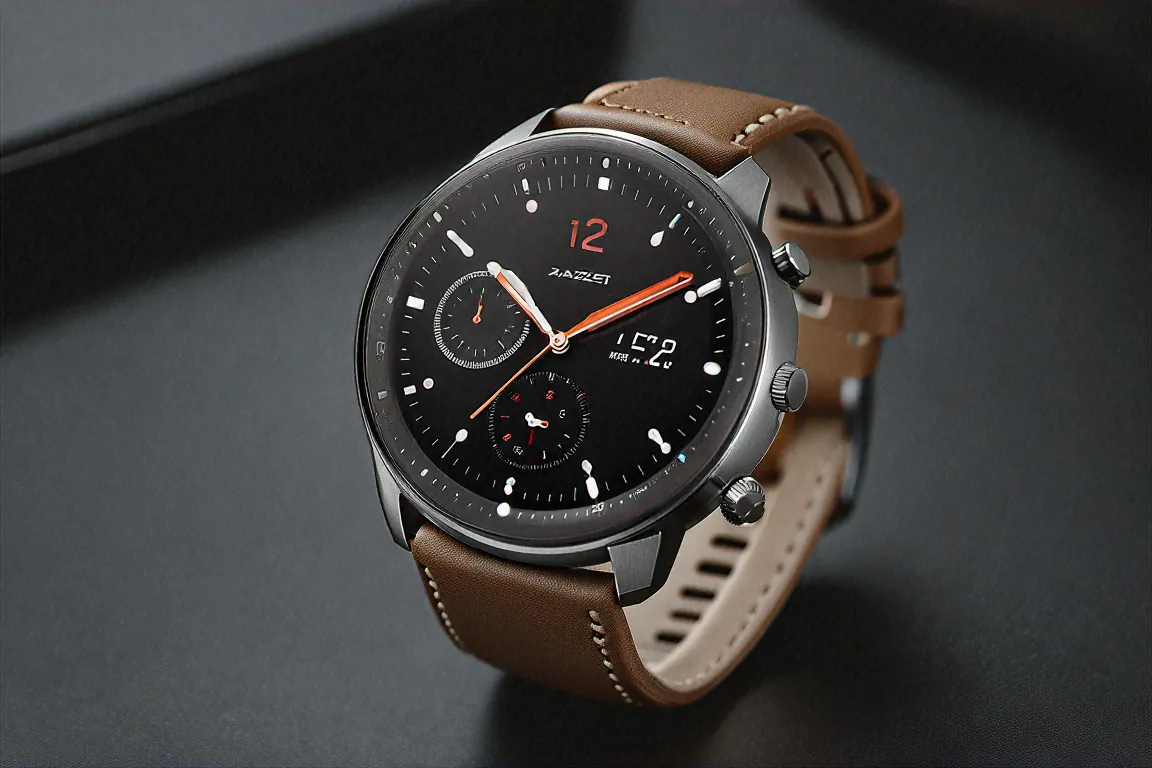
The GTR 4 goes for a classic look. Round case, 46mm, with a metal frame and flat glass front. No dome glass like the Pixel Watch — this is flat, which I actually prefer because it catches fewer accidental taps and reflections. Amazfit says it's sapphire-coated glass, which is slightly less scratch-resistant than full sapphire crystal but better than standard mineral glass.
Two colourways: Titanium Grey and Black. I tested the Titanium Grey, which has a nice brushed-metal look that pairs decently with both casual and semi-formal outfits. The Black version is more overtly sporty. Neither looks particularly expensive — at Rs 19,999, you're not getting the premium heft of a Samsung titanium case — but neither looks cheap either. They exist in a comfortable middle ground.
The physical crown on the right side is tactile and satisfying. Rotating it scrolls through menus with haptic feedback. Below it, a function button provides quick access to workout modes. Between these two physical controls and the touchscreen, navigation is intuitive. I preferred it to pure-touchscreen interfaces after a few days.
Strap is a standard 22mm quick-release. Bless Amazfit for not going proprietary. I swapped it for a nylon NATO strap from Amazon within the first week — cost Rs 299 and gave the watch a completely different personality. The included silicone strap is comfortable but generic.
At 52 grams with the strap, this is a light watch for its size. Sleeping with it is comfortable — something I can't say about the 49mm Apple Watch Ultra or even the Samsung Watch 7 Ultra's square case.
Display: Bright Enough Where It Counts
1.43-inch AMOLED at 1,000 nits peak brightness and 331 PPI. These numbers translate to a display that's sharp, colorful, and readable outdoors in everything short of direct overhead noon sun. Morning and evening? Perfect. Under fluorescent office lights? Gorgeous. Driving with the sun on my wrist through the car window? Perfectly fine.
The always-on display mode is available but costs battery. With AOD on, my 13-day battery dropped to 8-9 days — still excellent compared to most smartwatches but a significant reduction. I kept AOD off because the wrist-raise-to-wake is fast enough (under 300ms, I'd estimate) that I never missed having a perpetually-lit screen.
Watch face selection is large. Amazfit's own designs range from data-heavy sport faces showing four-five complications simultaneously to minimal analogue faces that just show time. I cycled through about a dozen over the testing period and found at least five I genuinely liked, which is more than I can say for some competitors.
Health and Fitness: Where the Price Surprises You
The BioTracker 4.0 sensor — Amazfit's latest generation — handles heart rate, SpO2, skin temperature, and stress monitoring. Let me share actual numbers because that's what matters.
Tested heart rate accuracy against a Polar H10 chest strap during five different activities: resting, walking, jogging, interval training, and weight lifting. Resting and walking accuracy was within 2-3 BPM. Jogging was within 4-5 BPM. Interval training had spikes of 8-10 BPM variance during rapid heart rate changes — the wrist sensor simply can't keep up with sudden jumps as well as a chest strap. Weight lifting was inconsistent, reading 10+ BPM off during exercises with tight wrist flexion.
These numbers are comparable to Samsung and Apple watches in my experience, with the exception of the interval training, where the premium watches' newer sensors recover faster. For steady-state exercise and general daily monitoring, the BioTracker 4.0 is perfectly adequate.
Sleep tracking is genuinely good. Zepp OS 4's sleep analysis includes total sleep time, light/deep/REM stage breakdown, breathing quality, and a sleep score. Compared against the Pixel Watch 3's Fitbit-powered sleep tracking over a week of simultaneous wear, stage breakdowns were similar — not identical, but within reasonable variance. The sleep score calculation seems to weight deep sleep heavily, which means nights with 90+ minutes of deep sleep consistently scored above 80, while nights with under 60 minutes scored in the 60s. This matched my subjective sense of how rested I felt.
Zepp Coach is Amazfit's AI training feature. Feed it your fitness data for a week, tell it your goals (I said "improve 5K time"), and it generates a multi-week training plan with specific daily workouts. The plan it gave me was reasonable — alternating easy runs, tempo runs, and rest days — though nothing a basic running coach wouldn't also suggest. The value is in having it on your wrist, telling you exactly what to do when you start a workout. Removed the decision fatigue from my running routine.
150+ sports modes. I used about six: outdoor running, treadmill, gym (free training), yoga, walking, and cycling. Each logs duration, heart rate, calories, and activity-specific metrics where applicable. The GPS-tracked activities (running, cycling) were accurate — more on GPS below.
Dual-Band GPS: Actually Good
L1 plus L5 dual-band GPS is a feature I wouldn't have expected at Rs 19,999 two years ago. It's now table stakes for serious fitness watches, and the GTR 4 delivers.
Ran my standard test route near Cubbon Park — a 5km loop with a mix of open roads, tree-lined avenues, and a section near tall buildings. The GTR 4's GPS track, overlaid on Google Maps satellite view, followed the actual path closely. Deviation was visible only in the narrow lane section between buildings, where it drifted 3-4 metres. In open areas, it was essentially on the road.
Compared to a Garmin Forerunner 265 on the same route, the GTR 4 measured 5.04 km versus the Garmin's 5.01 km. Negligible difference. GPS lock time was 10-15 seconds outdoors — slower than the Garmin's near-instant lock but fast enough that I wasn't standing around impatiently.
For cycling, I did a 40km ride around the outskirts of Bangalore. The recorded route tracked accurately through rural roads, highway stretches, and a few underpass sections. Total distance matched my bike computer within 0.3 km. Good enough for me.
Software: Zepp OS 4 Is Fine. Just Fine.
Here's where the GTR 4 reveals its mid-range positioning. Zepp OS 4 is proprietary — not Wear OS, not watchOS. This means no Google Play Store, no Google Maps on the wrist, no third-party app ecosystem to speak of. You get Amazfit's built-in apps and a handful of "mini apps" in the Zepp store, most of which are watch faces or simple utilities like a calculator or timer.
Notifications come through fine — WhatsApp, Gmail, calls, Instagram, whatever. You can read them in full. You cannot reply to them from the watch. Not with voice, not with canned responses, not at all. If a notification requires any action beyond reading, you're pulling out your phone. Coming from Wear OS where I could type a quick reply from my wrist, this felt like a meaningful step backward.
Alexa voice assistant is integrated. It works for setting timers, asking about weather, and basic queries. It does NOT work for controlling the watch's settings, starting workouts, or anything that requires on-device action. Limited utility, honestly.
Music control works — play, pause, skip, volume — for whatever's playing on your phone. No on-device music storage. No Spotify offline. If you want to run without your phone and still have music, you need a different watch.
The Zepp app on the phone is where you dig into health data, configure the watch, and manage watch faces. It's clean and functional. Export options are limited — you can't easily dump raw data into a spreadsheet like you can from Garmin Connect. For most users this won't matter. For data nerds, it's frustrating.
| Specification | Details |
|---|---|
| Display | 1.43-inch AMOLED, 1,000 nits, 331 PPI |
| Battery | 14 days standard; 30 days light use |
| GPS | Dual-band L1 + L5 |
| Water Resistance | 5ATM + IP68 |
| Sports Modes | 150+ |
| Sensors | BioTracker 4.0 (HR, SpO2, temperature, stress) |
| OS | Zepp OS 4 (proprietary) |
| Connectivity | Bluetooth 5.3, optional Wi-Fi |
| Calling | Not available |
| Price | Rs 19,999 |
What's Missing and Whether It Matters
No Bluetooth calling. At all. If you're used to taking quick calls from your wrist, the GTR 4 can't do that. Incoming call notifications show up and you can reject them, but answering requires your phone. This is a dealbreaker for some people and irrelevant for others. Personally, I use wrist calling maybe twice a week, so it's a mild inconvenience rather than a showstopper.
No WhatsApp reply. Already mentioned this, but it bears repeating because Indian usage patterns revolve around WhatsApp. Read-only notifications on a watch feel incomplete in 2026.
No NFC payments. No Google Pay, no Apple Pay, no contactless anything. Not unusual at this price but worth noting.
The notification management is less polished than Samsung's or Google's. Sometimes notifications arrive 2-3 seconds after my phone buzzes. Occasionally they miss entirely — maybe one in fifty — requiring a Bluetooth reconnection. Minor stuff, but noticeable when you've used premium alternatives.
The Experience Over Five Weeks
Started wearing the GTR 4 as a dedicated test. Ended up wearing it because I wanted to. The battery life changed my relationship with the device — I stopped babying it and started treating it like a tool. Wore it while gardening, while cooking, during a particularly dusty Holi celebration. Water resistance held. Build quality held. The watch just... worked.
Sleep tracking became my favourite feature. Something about Zepp's sleep score motivated me to optimise my sleep in a way that Samsung Health's more detailed-but-overwhelming sleep analysis didn't. Maybe simplicity is more motivating than completeness. Getting a "73" and wanting to beat it tomorrow is a cleaner loop than parsing REM percentages and deep sleep minutes.
Zepp Coach's running plan helped me take my 5K time from 34 minutes to 31 minutes over four weeks. Nothing dramatic, but consistent improvement with structured guidance. The watch would vibrate when I was running too fast or too slow relative to the day's target pace. Primitive compared to a Garmin's running dynamics, but effective for a recreational runner who doesn't need lactate threshold estimates.
Pros
- 12-13 day battery life in real-world testing — best-in-class at this price
- Dual-band GPS performs surprisingly well for a Rs 19,999 watch
- Zepp Coach AI training plans are simple but effective
- Premium metal round design with standard 22mm bands
- 1,000-nit AMOLED readable in most outdoor conditions
- Sleep tracking is among the best in the mid-range
Cons
- Zepp OS 4's third-party app ecosystem is nearly nonexistent
- No Bluetooth calling whatsoever
- Can't reply to notifications from the watch
- Notification delivery is occasionally delayed or missed
- No on-device music storage or offline Spotify
Women's Health and Other Tracking Features
Menstrual cycle tracking with period predictions and fertility window estimates is included. My wife tested this over a full cycle using the Zepp app, and the predictions were within 1-2 days of her actual dates. Not medical-grade, but useful for planning. The notifications are discreet — just a small icon on the watch face, nothing that announces itself to the world.
PAI (Personal Activity Intelligence) is Amazfit's gamification layer. It converts all your daily activity — steps, workouts, even active standing — into a single number that you try to keep above 100 per week. The concept is borrowed from research at the Norwegian University of Science and Technology, and there's actual clinical evidence that maintaining a PAI score above 100 correlates with reduced cardiovascular disease risk. Whether or not you care about the academic backing, the gamification works. Seeing my PAI drop to 85 on a lazy Sunday motivated me to go for an evening walk. That's the point.
Breathing exercises via "Zepp Aura" are guided relaxation sessions you can run from the watch. Vibration patterns guide your inhale and exhale timing. I tried it during a particularly stressful deadline week. Felt marginally calmer afterward. Probably placebo. Used it four times, then forgot it existed. Make of that what you will.
Who Should Buy the Amazfit GTR 4
I'll be specific because this watch suits a particular person extremely well and frustrates everyone else.
Buy this if: you run, cycle, or hike regularly and want accurate GPS tracking with battery that lasts between weekends. You value fitness data — steps, heart rate, sleep, workout logs — but don't need to reply to WhatsApp from your wrist. You want a watch that looks like a watch, not like a tiny computer. You're on a Rs 20,000 budget and refuse to compromise on GPS and battery.
Skip this if: you want a full smartwatch experience with apps, payments, and message replies. You take calls from your wrist frequently. You're deep in the Google or Samsung ecosystem and expect tight integration with those services. You prioritize software sophistication over hardware endurance.
My specific recommendation: if you're an outdoor fitness enthusiast in India who wants the best possible battery life and GPS accuracy under Rs 20,000, the Amazfit GTR 4 is the watch. Not one of the options — THE option. Nothing else at this price delivers this combination. The OnePlus Watch 3 at Rs 24,999 gives you Wear OS and a richer smartwatch experience but a fraction of the battery. The Samsung Galaxy Watch FE at a similar price gives you Samsung Health but GPS accuracy and battery that lag behind. The GTR 4 owns its niche and owns it completely.
Price in India
The Amazfit GTR 4 is priced at Rs 19,999. Available on Amazon India, Flipkart, and Amazfit India's own website. I've seen it dip to Rs 17,499 during festive sales — at that price, it's an absurdly good deal.



Comments (0)
Leave a Comment
No comments yet. Be the first to share your thoughts!