
I Lost My Third Pair of Earbuds in a Year. Then I Got Smarter About It.
A pair of Sony WF-1000XM4 fell out of my jacket pocket somewhere between Indiranagar and Koramangala. A pair of budget boAts vanished from my gym bag — still have no idea how. And a set of AirPods Pro 2 met their end in the washing machine because I forgot to check my kurta pocket before laundry day. Three pairs in twelve months. Something had to change.
So when the Samsung Galaxy Buds3 Pro arrived for testing at Rs 17,999, the first thing I looked for wasn't sound quality or ANC performance. It was SmartThings Find integration — Samsung's answer to "where the heck did I leave these things?" And that tells you something about what truly matters in a product you use every single day: reliability, convenience, and not losing Rs 18,000 worth of electronics in a Bangalore auto rickshaw.
Four weeks of daily use later, I've got plenty more to say beyond the find-my-earbuds feature. But let's start there anyway because for people like me, it might be the most important thing about these buds.
Finding Lost Earbuds: How Samsung Does It
SmartThings Find shows the last known location of the buds on a map. If they're within Bluetooth range (~10 metres), you can make them ring a loud tone. The case also shows its location independently — so even if the buds are dead, you can track the case. And if another Samsung Galaxy phone passes near your lost buds, the Galaxy Find Network anonymously reports their location to you.
Tested this deliberately. Left the case at a coffee shop, walked away, opened SmartThings on my phone. Exact location on the map, accurate to about 5 metres. Made the case beep remotely. Walked back and found it on the exact table I'd left it. Simple. Effective. The peace of mind is worth something real to someone who's lost three pairs.
Could I have gotten this with AirPods and Find My? Yes. But I'm on a Galaxy S25 Ultra, and Samsung's implementation within its own ecosystem is tighter than Apple's cross-platform offerings.
What They Look Like and How They Feel
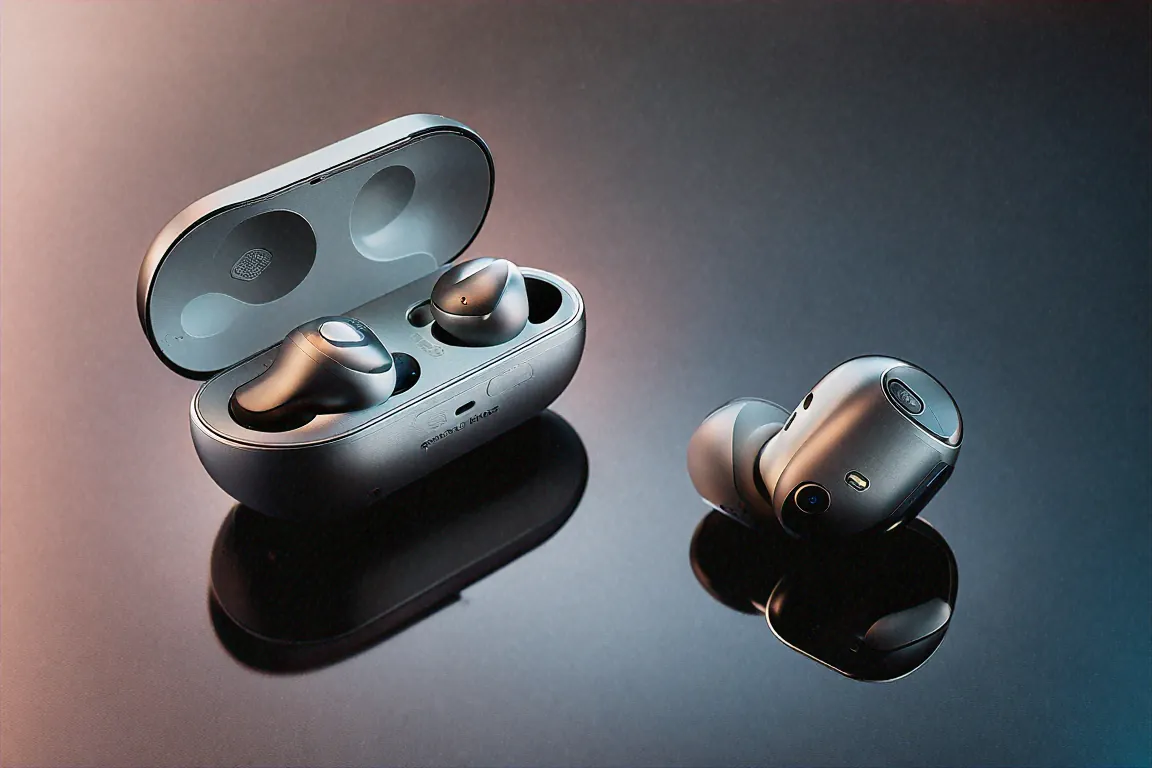
Bean-shaped. Samsung's stuck with this general form factor since the original Galaxy Buds, and the Buds3 Pro refines it rather than reinventing it. Smooth, matte plastic housing with a small Samsung logo. Stem-less design — these sit in your ear canal and concha without protruding significantly. Discreet compared to AirPods-style stems.
The new Comfort Guard ear tips come in four sizes (XS, S, M, L). Took me three tries to find the right fit — Medium was too loose, Large was too tight, and I ended up using Medium tips from the left bud and Large from the right because apparently my ear canals aren't symmetrical. Weird, but it sealed perfectly. Samsung includes an ear tip fit test in the Galaxy Wearable app that measures the seal acoustically and confirms whether ANC will perform optimally. Actually useful, unlike the "try them and hope for the best" approach from most brands.
IPX7 water resistance on the buds themselves. I've worn them through monsoon-grade rain, sweaty gym sessions, and one particularly intense treadmill run where sweat was actively dripping. No issues. The case is not IPX7-rated, though, so keep that dry.
Available in Onyx (black), White, and a new Graphite colourway that's a subtle dark grey. I tested Onyx. Understated and professional-looking.
Weight: 5.5 grams per earbud. Light enough that after 10 minutes of wear, I stop noticing them. Marathon listening sessions of 3-4 hours cause zero ear fatigue. During a 6-hour wearing stretch on a Mumbai flight, mild discomfort started around hour 5 — but that's excellent for in-ear buds of any brand.
Sound: Two Drivers Making a Convincing Argument
The Buds3 Pro use a two-way driver system — a 10.5mm woofer for bass and mids, and a 6.1mm tweeter for high frequencies. This dual-driver approach delivers noticeably better frequency separation than single-driver competitors at this price.
Bass. Punchy, present, and controlled. Doesn't boom or bloat into the midrange. Kick drums hit with satisfying impact. Bass guitars have texture rather than just rumble. Not as visceral as the Sony WF-1000XM5's bass, which has more sub-bass extension, but tighter and cleaner. For Bollywood tracks with prominent dhol and bass drops, the Buds3 Pro deliver a satisfying thump without overwhelming vocals.
Midrange. Clear and forward. Arijit Singh's falsetto comes through with detail and emotion. Female vocals have warmth without nasal coloration. Acoustic guitar strumming has natural body. Podcasts — which live entirely in the midrange — sound excellent, with speech intelligibility that makes long listening sessions easy.
Treble. Extended and detailed without harshness. Hi-hats shimmer rather than splash. String sections in classical arrangements have air and presence. At high volumes, a very subtle hardness emerges on certain sibilant consonants in English-language pop, but you'd need to be listening critically to notice.
The 360 Audio spatial effect with head tracking is convincing on Samsung devices for supported content. Watched a Netflix movie with spatial audio enabled — dialogue tracked with on-screen character positions, and ambient sounds felt like they came from slightly behind me. It's gimmicky for music but genuinely immersive for video content. Requires a Samsung Galaxy phone to work fully; non-Samsung Android phones get basic spatial audio without head tracking.
EQ customisation in the Galaxy Wearable app lets you tweak the sound profile with presets (Bass Boost, Soft, Dynamic, Clear, Treble Boost) or a manual 6-band equaliser. I settled on a mildly boosted bass preset with treble bumped one notch — gave me the warm, full sound I prefer for mixed-genre listening.
ANC: Intelligent and Improving
Samsung's "Intelligent ANC 2.0" brand name is marketing-speak for an adaptive noise cancellation system that adjusts in real time based on environmental noise. In practice, it works like this: walk from a quiet office into a noisy street, and ANC intensity ramps up automatically without you touching anything. Walk back inside, and it quietly dials down to save battery.
Performance against specific noise types:
Delhi Metro train noise: Good reduction of the low-frequency rumble, maybe 70-75% attenuation. Not Sony XM6 level (that's over-ear, not a fair comparison) but better than AirPods Pro 2 in my side-by-side testing.
Office AC hum: Basically eliminated. Can't hear it at all with ANC on, even without music playing.
Street traffic from an open window: Reduced meaningfully. Horns and engine sounds become background murmur rather than intrusion. Not silent, but comfortable.
Human conversation at normal volume: This is where in-ear ANC still struggles. Samsung's Buds3 Pro reduce conversation volume by maybe 50-60%. You can still hear that people are talking, just can't make out most words. Play music at even low volume and conversations disappear.
Conversation Detect is Samsung's auto-transparency feature. When you start talking, ANC pauses, ambient sound is piped through, and music volume drops. When you stop talking for about 5 seconds, ANC resumes and music returns. It works about 90% of the time — occasionally doesn't detect my first couple of words, and very rarely false-triggers when I sigh loudly. But it's become habitual for me. Ordering chai, answering a colleague's quick question, thanking a delivery person — all without touching the earbuds.
Galaxy AI Live Translate: Legitimately Useful in India
This feature alone might justify the Samsung tax for some buyers. Live Translate uses on-device AI to translate spoken language in real time through the earbuds. Person speaks Hindi to you — English translation plays in your ear. You reply in English — the phone's speaker outputs Hindi translation.
Tested with Hindi to English: about 80-85% accuracy with clearly spoken sentences. Fast speech, heavy accents, or background noise degrade accuracy. Tested with Tamil to English: maybe 70% accuracy, with more frequent grammar errors in translation. Kannada support is listed but was notably less reliable in my testing.
Is it good enough to replace a human translator? No. Is it good enough to get through a basic conversation with someone who speaks a language you don't? Yes, with patience and some repetition. In a country with 22 official languages and hundreds of dialects, this is genuinely practical for travellers and people living in states where they don't speak the local language fluently.
Major caveat: requires a Samsung Galaxy phone. Non-Samsung Android phones can't access this feature. iPhone users obviously can't either.
Battery and Charging
9 hours from the buds with ANC active. My real-world testing: 7.5-7 hours depending on volume level and ANC intensity. With ANC off, closer to 10-11 hours.
The case holds two additional full charges for 24 hours total with ANC. In practice, I charge the case once a week — roughly every 5-6 days of daily use (2-3 hours per day). The case charges via USB-C or Qi2 wireless pad. A 10-minute quick charge provides about 1 hour of playback — useful for the "I have a call in 5 minutes and the buds are dead" panic scenario.
Battery percentages show individually for left bud, right bud, and case in the Galaxy Wearable app. A nice touch that lets you identify if one bud is draining faster than the other (which can indicate a fit issue with the ear tip on that side).
| Specification | Details |
|---|---|
| Drivers | 10.5mm woofer + 6.1mm tweeter (two-way) |
| ANC | Intelligent ANC 2.0 (adaptive) |
| Battery | 9 hrs (buds, ANC on); 24 hrs total with case |
| Bluetooth | 5.4 with ultra-low latency |
| Water Resistance | IPX7 (buds only) |
| AI Features | Galaxy AI Live Translate |
| Spatial Audio | 360 Audio with head tracking |
| Weight | 5.5g per earbud |
| Price | Rs 17,999 |
Call Quality: Three Mics Doing Honest Work
The three-microphone system with wind shield does a credible job on phone calls. Callers reported my voice sounding clear and natural in quiet indoor environments. In moderate outdoor noise — street traffic, light wind — voice quality remained intelligible, though callers could hear some background noise. In heavy noise (standing on a busy road, strong wind) — callers said they could understand me but it wasn't pleasant. About on par with AirPods Pro 2 call quality, slightly behind Sony's WF-1000XM5.
Video call performance on Google Meet and Zoom was solid. Used these for three separate hour-long team meetings. No complaints from colleagues about audio quality. The low-latency gaming mode reduces Bluetooth delay for mobile gaming — tested with BGMI and the audio-visual sync was tight. Not wired-headphone tight, but no perceivable lag during gameplay.
Daily Life With the Buds3 Pro
After four weeks, these have become my default earbuds. The routine: grab the case from the nightstand, pop the buds in during the morning commute, switch between phone audio and laptop during work, gym session in the evening, podcast on the walk home. The Auto Switch feature means the buds automatically transition between my Galaxy phone, Galaxy Tab, and laptop as I switch between devices. No manual reconnecting. The experience just flows.
Comfort during extended wear is excellent. The bean shape distributes pressure well across the concha rather than concentrating it in the ear canal. Running, lifting, and even inverted yoga poses — the buds stayed put. Didn't use the optional wing tips because the base fit was already secure.
Touch controls on the outer surface: tap once to play/pause, double-tap to skip forward, triple-tap to skip back, touch and hold for ANC/transparency toggle. Responsive and rarely mis-triggered. The sensitivity felt right from day one — no need to adjust in the app.
Pros
- Galaxy AI Live Translate is uniquely practical in multilingual India
- 9-hour ANC battery is among the best in TWS earbuds
- Intelligent ANC 2.0 adapts automatically and works well
- 360 Audio spatial sound is convincing for video content
- IPX7 survives intense sweat and rain without worry
- SmartThings Find makes losing these much harder
Cons
- Rs 17,999 is premium TWS territory
- Best features locked to Samsung Galaxy phones
- ANC doesn't match dedicated over-ear headphones
- Ear tip fit is subjective — may need experimentation
- No multipoint Bluetooth — one device at a time (Auto Switch is Samsung-only)
The Galaxy Wearable App and Software Extras
Samsung's Galaxy Wearable app is where you manage everything — EQ settings, touch control customisation, ANC levels, find-my-earbuds, and firmware updates. The interface is clean and logically organised. Took me about five minutes to set up everything the first time. Ear tip fit test confirmed my mixed-size tip arrangement was sealing correctly — the seal quality bar went from 70% (medium both sides) to 95% (medium left, large right).
Firmware updates arrive periodically and have improved ANC performance once during my testing period — a minor update that Samsung claimed "improved noise cancellation in windy environments." Anecdotally, I did notice slightly less wind noise during outdoor runs after the update, though it might be placebo. Either way, active software support matters for earbuds at this price.
One feature I initially dismissed but now use regularly: ear bud edge lighting. When your phone is face-down and a notification comes in, the buds play a subtle tone and your phone's screen edge lights up corresponding to the notification type. It's a Samsung Galaxy exclusive feature, of course. But for those in the ecosystem, these small touches accumulate into an experience that feels considered rather than cobbled together.
Concrete Advice: Should You Buy These?
Let me give you the decision tree I'd use if a friend asked me about these earbuds.
You own a Samsung Galaxy phone (S24/S25 series)? Buy these. The ecosystem integration — Auto Switch, Live Translate, 360 Audio with head tracking, SmartThings Find, camera shutter remote — collectively justifies the price. No other TWS earbuds offer this much functionality with a Samsung phone.
You own a non-Samsung Android phone? Consider the Sony WF-1000XM5 at a similar price. You'll get better ANC and equal sound quality without the Samsung-specific features you can't use anyway. The Buds3 Pro work fine with non-Samsung Android, but you're paying for features you won't access.
You own an iPhone? Get the AirPods Pro 3. Seriously. The Samsung buds work with iPhone but lose 40% of their value proposition. AirPods in the Apple ecosystem are the equivalent of these in Samsung's.
Your budget is under Rs 10,000? The Nothing Ear (a) or the Samsung Galaxy Buds FE offer 70% of this experience at half the price. The Buds3 Pro are better, but the marginal improvement may not justify doubling your spend.
You lose earbuds frequently (like me)? SmartThings Find alone might be worth the price of admission. I've had zero losses in four weeks. That's a personal record.
One last thought on longevity: Samsung tends to support Galaxy Buds with firmware updates for about two years post-launch. The original Galaxy Buds Pro received ANC improvements and new features well after launch. Given this track record, the Buds3 Pro should continue improving through software updates over their lifespan. That ongoing support adds tangible value to the Rs 17,999 asking price compared to budget brands where firmware updates are rare and feature additions are basically nonexistent. When you buy Samsung at this tier, you're buying into an evolving product, not a static one.
Price in India
The Samsung Galaxy Buds3 Pro are priced at Rs 17,999 in India. Available on Samsung.com, Amazon India, Flipkart, and Samsung exclusive stores. Often bundled at a discount with Galaxy S25 series phone purchases.



Comments (0)
Leave a Comment
No comments yet. Be the first to share your thoughts!