
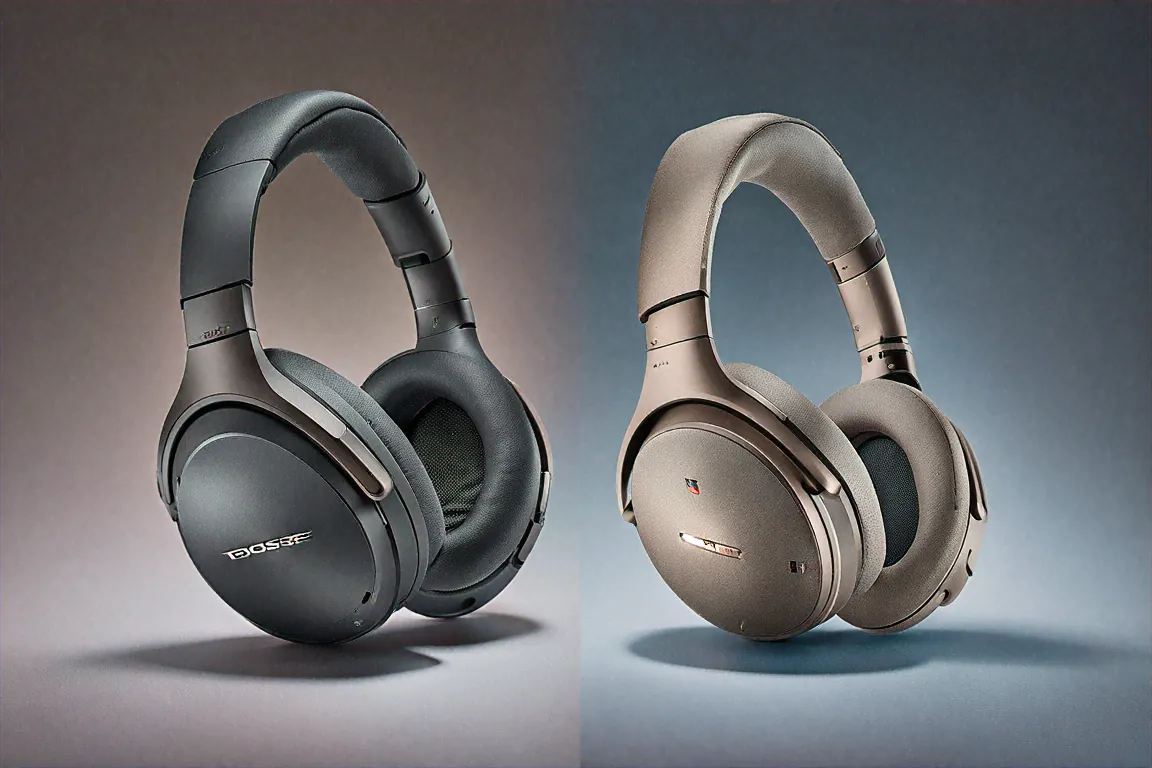
The Sony WH-1000XM5 and the Bose QuietComfort 45 are the two most popular premium active noise cancelling headphones in India — and for good reason. Both deliver exceptional noise cancellation, comfortable all-day wear, and premium audio quality that transforms your daily commute, work-from-home sessions, and travel experience. At Rs 29,990 for the Sony and Rs 26,900 for the Bose on Amazon India, they are significant investments that most buyers will live with for three to five years. Choosing between them requires understanding nuanced differences in sound signature, noise cancellation approach, codec support, and comfort.
We tested both headphones simultaneously for three weeks across the full spectrum of Indian noise environments — the Delhi Metro during rush hour, an auto-rickshaw ride through Bengaluru's Koramangala, a co-working space with background chatter and AC hum, a domestic flight from Delhi to Mumbai, and late-night listening sessions at home. This comparison covers every dimension that matters for the Indian buyer: noise cancellation effectiveness, sound quality across different music genres, codec support (critical for Android users), call quality, comfort, and after-sales support.
Design and Build Comparison
The Sony WH-1000XM5 represents a significant design departure from the XM4. The headband uses a seamless, stepless slider mechanism with synthetic leather padding. The ear cups are thinner, lighter, and use softer cushions that conform to different head shapes. The overall weight is 250 grams — 4 grams lighter than the XM4 and 4 grams lighter than the Bose QC45. The design trade-off is that the XM5 does not fold — the ear cups swivel flat but do not collapse into a compact fold like the XM4 or the Bose. The included carrying case is consequently larger — a meaningful consideration for travellers with limited bag space.
The Bose QC45 retains the classic Bose over-ear design that has been refined over decades. The headband uses a traditional adjustable click mechanism with plush cushioning. The ear cups are deeper, creating more space around the ears for larger ear sizes. At 240 grams, the Bose is 10 grams lighter than the Sony. Critically, the QC45 folds into a compact configuration for storage in its included case, which is significantly smaller than the Sony's case — an advantage for commuters and travellers.
Both headphones use plastic as the primary construction material, which is standard for this category — metal would increase weight to the point of discomfort during extended wear. The Sony's plastic feels slightly more premium with a matte finish that resists fingerprints. The Bose has a subtle texture that provides a different tactile quality. Both feel durable and well-assembled, with no creaking or flex.
Colour options in India: the Sony is available in Black and Platinum Silver. The Bose comes in Black and White Smoke. Both colour options look professional and appropriate for office and travel use.
Active Noise Cancellation Comparison
Both headphones use multi-microphone ANC systems — the Sony employs eight microphones (four on each ear cup) with a dedicated V1 processor, while the Bose uses six microphones (three per side). The Sony's additional microphones and dedicated processor give it a slight technical edge that translates to measurably better cancellation in certain scenarios.
Delhi Metro during rush hour: The constant low-frequency rumble of the train, combined with conversations, announcement speakers, and the whoosh of doors, creates a complex noise environment. The Sony cancelled approximately 90 percent of the Metro noise — the deep rumble was almost completely eliminated, and conversations became an unintelligible murmur. The Bose cancelled approximately 85 percent of the same noise — excellent, but the low-frequency rumble was slightly more perceptible. Both made the Metro journey dramatically more bearable for music listening and podcast consumption.
Auto-rickshaw in Bengaluru traffic: This is the ultimate noise torture test — a combination of engine drone, traffic horns, road noise, wind turbulence, and the driver's phone blaring music simultaneously. The Sony reduced this chaos by roughly 80 percent, making music listenable at moderate volumes. The Bose achieved approximately 75 percent reduction. Neither headphone completely eliminates auto-rickshaw noise (the irregular horn blasts and sudden loud sounds punch through any ANC), but both transform the experience from unbearable to manageable.
Air-conditioned office: Both headphones effectively eliminated AC hum, keyboard clicks, and distant conversations, creating a focused work environment. In this controlled setting, the difference between the two was minimal — both achieved near-complete cancellation of steady office noise.
Domestic flight: On a Delhi to Mumbai IndiGo flight, both headphones performed exceptionally. Engine drone was reduced to a faint background hum on both. The Sony had a slight edge in cancelling the higher-frequency whoosh of air through the cabin, but the difference was marginal.
Sound Quality Comparison
Sound quality is subjective, but both headphones have distinct sonic signatures that appeal to different listener preferences.
The Sony WH-1000XM5 uses newly designed 30mm carbon fibre composite drivers (down from 40mm on the XM4). Despite the smaller driver size, the sonic performance is impressive. The sound signature is balanced with a slight emphasis on bass — providing satisfying low-end punch without overpowering the mids and highs. Vocal clarity is excellent — AR Rahman's layered compositions and Arijit Singh's melodic vocals are rendered with emotional detail. The soundstage is wide for a closed-back headphone, creating a sense of space that makes orchestral Bollywood soundtracks and Western classical music feel immersive.
The Bose QC45 uses proprietary TriPort acoustic architecture with 35mm drivers. The Bose sound signature is warmer and more mid-forward than the Sony. Vocals are pushed slightly ahead in the mix, making spoken content (podcasts, audiobooks, Zoom calls) exceptionally clear. Bass is present and punchy but slightly less extended than the Sony's — the very lowest sub-bass frequencies are not as pronounced. The treble is smooth and non-fatiguing, which makes the Bose more forgiving with poorly mastered tracks and compressed audio from YouTube and Spotify's default quality settings.
For Bollywood and Indian classical music — which emphasise vocal performance, tabla rhythms, and complex mid-range instrumentation — both headphones excel. The Sony's wider soundstage gives orchestral and ensemble pieces more spatial presence. The Bose's vocal emphasis makes ghazals, solo vocal performances, and conversation-heavy podcasts more intimate and engaging.
For Western pop, hip-hop, and EDM, the Sony's stronger bass extension provides more impact and energy. For jazz, acoustic, and vocal-centric Western genres, the Bose's warm mid-range is equally appealing. In short, neither headphone has a bad sound — they have different sound signatures that cater to different preferences.
Codec Support: Critical for Android Users
This is the single most important technical difference between these headphones, and it disproportionately affects the majority of Indian smartphone users who are on Android.
The Sony WH-1000XM5 supports LDAC, AAC, and SBC codecs. LDAC is Sony's high-resolution Bluetooth codec that transmits audio at up to 990 kbps — roughly three times the bandwidth of AAC (256 kbps) and six times SBC (328 kbps). On Android phones that support LDAC (virtually all modern Android phones including Samsung Galaxy, OnePlus, Xiaomi, POCO, Pixel, and Realme), the Sony XM5 delivers noticeably better audio quality. The difference is audible — cymbals shimmer with more detail, bass has tighter definition, and the overall presentation sounds more natural and less compressed.
The Bose QC45 supports only AAC and SBC codecs. This means that on Android phones, the Bose is limited to AAC (which Android handles less efficiently than iOS) or SBC (which is audibly inferior). The practical result is that on a Samsung Galaxy or OnePlus phone, the Sony XM5 over LDAC sounds measurably better than the Bose QC45 over AAC. This is not an audiophile placebo — the bandwidth difference is significant enough that casual listeners in our testing group identified the Sony as better-sounding on Android phones.
On iPhones, the playing field levels. Both headphones are limited to AAC on iOS (Apple does not support LDAC), and at AAC quality, the sonic differences are driven by the headphones' own tuning rather than the codec. iPhone users do not benefit from the Sony's LDAC advantage.
Given that approximately 95 percent of Indian smartphone users are on Android, the Sony's LDAC support represents a significant real-world audio quality advantage for the vast majority of Indian buyers. This single factor is, in our assessment, the most compelling reason to choose the Sony over the Bose for Android users.
Transparency and Ambient Modes
Both headphones offer transparency modes that let outside sound through the headphones — useful for hearing announcements, traffic sounds, and brief conversations without removing the headphones.
The Bose QC45's Aware mode sounds remarkably natural. Outside sound is passed through with minimal electronic artefact — voices sound like voices, traffic sounds like traffic, and the overall impression is close to wearing open-backed headphones. This naturalness is particularly valuable for walking on busy Indian roads where you need to hear approaching vehicles, auto-rickshaws, and hawkers.
The Sony XM5's ambient sound mode is functional but more processed. Outside sounds are clearly audible, but they carry a slightly electronic quality — a subtle amplification effect that makes voices sound slightly different from natural hearing. The Sony offers 20 levels of ambient sound adjustment, allowing fine control over how much outside noise passes through. The Bose offers a binary on-off toggle without intermediate levels.
For pedestrian safety on Indian roads — arguably the most important use case for ambient mode in India — the Bose's more natural transparency provides a slight safety advantage. You can more accurately judge the distance and direction of approaching vehicles when the ambient sound is less processed.
Call Quality and Microphone Performance
Both headphones use beamforming microphone arrays for voice calls, and both have improved significantly over their predecessors. However, meaningful differences exist.
The Sony XM5 uses four beamforming microphones with AI-based noise reduction that isolates your voice from background noise. In our testing during a Zoom call from a noisy Bengaluru cafe (background conversations, coffee machine, street traffic), colleagues reported that my voice was clear and intelligible, with background noise reduced to a faint murmur. Wind noise during outdoor calls was reasonably controlled, though not eliminated in gusty conditions.
The Bose QC45 uses a six-microphone system for calls. In the same cafe scenario, call quality was comparable to the Sony — clear voice isolation with effective background noise reduction. The Bose had a slight edge in wind noise rejection during outdoor calls, which matters for Indian users who frequently take calls while walking or waiting at bus stops.
Both headphones support multipoint connection — simultaneous pairing with two devices (e.g., laptop and phone). This is essential for work-from-home professionals who need to seamlessly switch between a Zoom call on the laptop and an incoming phone call without manual re-pairing.
Comfort for Extended Wear
Comfort during extended wear is critical for Indian work-from-home professionals who may wear headphones for 6 to 8 hours during a workday, and for commuters on long train or bus journeys.
The Sony XM5's synthetic leather ear pads are soft and conform to the shape of your ears. The headband pressure is moderate — secure enough to stay in place but not clamping. During an 8-hour workday test, comfort remained good through the first 5 hours, with mild warmth and slight pressure fatigue developing around hour 6. The synthetic leather does trap heat more than fabric, which matters in Indian conditions without air conditioning — ear sweating is noticeable after 3 to 4 hours in a 32-degree room.
The Bose QC45's ear pads are slightly deeper, creating more space inside the ear cup. The headband uses a different pressure distribution that many users find more comfortable for very long sessions. During the same 8-hour workday test, the Bose remained comfortable through approximately 6.5 hours before fatigue set in. The ear pads are also synthetic leather but feel slightly cooler — possibly due to the deeper cup allowing more air circulation. In the same 32-degree room, ear sweating was slightly less pronounced on the Bose.
For Indian users who spend long hours in non-air-conditioned environments, the Bose offers marginally better thermal comfort. In air-conditioned offices and homes, both headphones are comfortable for extended wear with periodic breaks.
Battery Life Comparison
The Sony WH-1000XM5 delivers 30 hours of playback with ANC active (40 hours without). The Bose QC45 delivers 24 hours with ANC active. This is a significant difference — the Sony lasts approximately 25 percent longer on a single charge. For daily commuters using headphones 2 to 3 hours per day, the Sony needs charging about once every 10 days versus the Bose's once every 8 days.
Quick charging is available on both. The Sony provides 3 hours of playback from a 3-minute charge. The Bose provides 2.5 hours from a 15-minute charge. The Sony's quick charge is significantly faster in a time-critical scenario — grabbing the headphones for a flight with only minutes to spare.
App and Smart Features
The Sony Headphones Connect app offers extensive customisation: an 8-band parametric equaliser, adaptive sound control (automatically adjusts ANC based on activity — sitting, walking, running, or in transit), DSEE Extreme upscaling for compressed audio sources, Speak-to-Chat (pauses music when you speak), and customisable touch controls on both ear cups. The app is feature-dense — almost overwhelming in its options — but it allows audiophiles and power users to tailor the headphone experience precisely to their preferences.
The Bose Music app takes a minimalist approach: a simple 3-band equaliser (bass, mid, treble), ANC level adjustment, shortcut button customisation, and firmware updates. The simplicity is intentional — Bose believes the headphones should sound great out of the box without extensive tweaking. For users who want to wear their headphones and listen without fiddling with settings, the Bose approach is more accessible.
After-Sales and Availability in India
Sony has an extensive authorised service network across India, with dedicated audio service centres in major cities. The WH-1000XM5 comes with a 1-year warranty. Replacement ear pads are available at Rs 1,500 to 2,000 on Amazon India and through Sony service centres. The headphones are widely available at Croma, Reliance Digital, Amazon India, and Flipkart, with prices regularly dropping to Rs 24,990 to 26,990 during festive sales — a significant discount from the Rs 29,990 MRP.
Bose operates through authorised resellers including the Bose Store India, Amazon India, Flipkart, and select Croma locations. The physical service centre presence is more limited than Sony's — concentrated in metros and tier-1 cities. Replacement ear pads for the QC45 cost Rs 2,000 to 2,500 for genuine Bose pads. The QC45 is priced at Rs 26,900 with occasional sale drops to Rs 22,990 to 23,990.
Which One Should You Buy
For Android users in India — which is the vast majority — the Sony WH-1000XM5 is the clear winner. LDAC codec support provides significantly better audio quality on Android phones compared to the Bose's AAC-limited connection. The 30-hour battery life is substantially longer. The ANC performance is marginally better in the most demanding noise environments. And the 8-band equaliser allows precise sound customisation for different music genres and personal preferences.
For iPhone users, the decision is closer. Both headphones are limited to AAC on iOS, eliminating Sony's biggest advantage. If you are an iPhone user who prioritises comfort for very long wear sessions, more natural transparency mode for road safety, and a compact foldable design for travel, the Bose QC45 at Rs 26,900 saves you Rs 3,000 while delivering an excellent experience that matches the Sony in most areas.
For work-from-home professionals who spend 6+ hours in headphones daily, the Bose's marginally better comfort for extended wear makes it worth considering regardless of phone platform. For frequent travellers, the Sony's superior battery life and better ANC are more important.
Both headphones are excellent products that will serve you well for years. But for the Indian market where Android dominance is overwhelming, the Sony WH-1000XM5's LDAC support gives it a decisive advantage. We rate the Sony 9.0 out of 10 and the Bose 8.5 out of 10 — both highly recommended, with the Sony earning our primary recommendation for Indian buyers.




Comments (0)
Leave a Comment
No comments yet. Be the first to share your thoughts!