
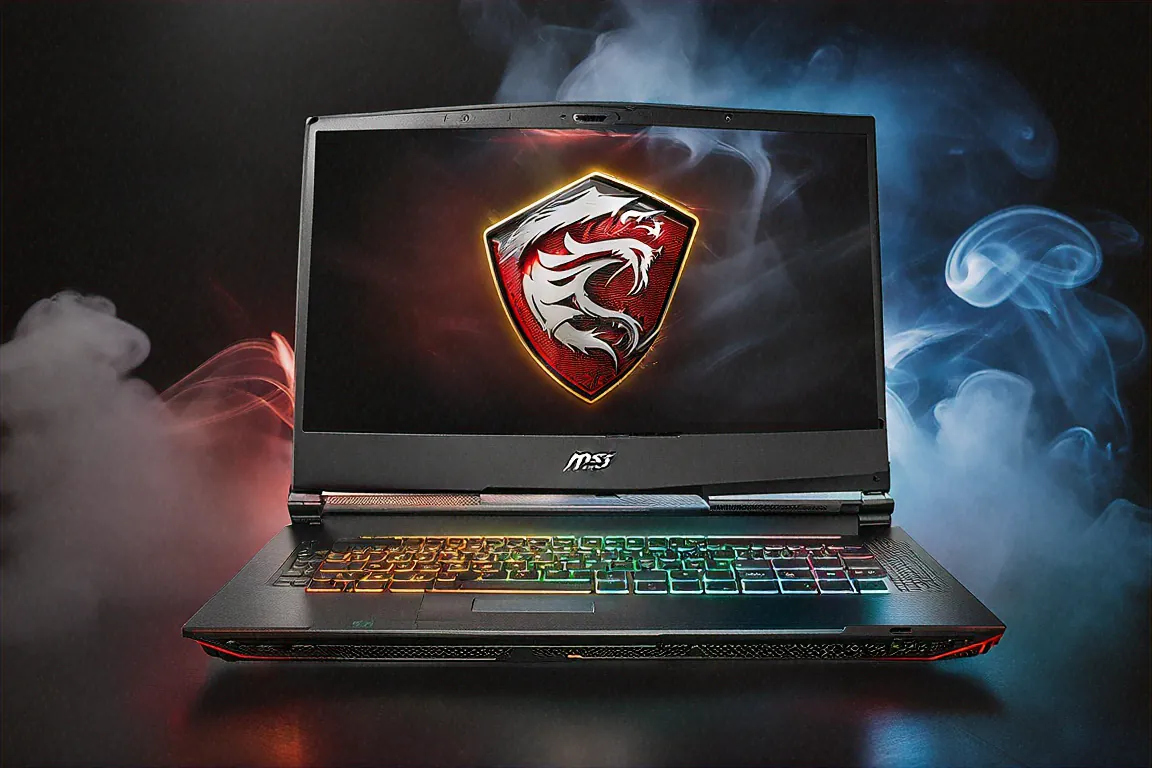
3.6 Kilograms of Laptop That Made Me Reconsider Everything
When the MSI Titan 18 HX arrived, I genuinely groaned lifting the box. Three point six kilograms — heavier than some carry-on suitcases I've packed. The 330W power brick added another kilo-plus. My first thought, written verbatim in my testing notes: "Who would buy a laptop this heavy?"
Four weeks later, I'm sitting at my desk wondering whether a desktop gaming PC even makes sense anymore. Because this absurd, overweight, over-engineered slab of aluminium and Cherry MX switches does things no laptop has any business doing. And once you accept that it's not really a "laptop" in the traditional sense — it's a portable desktop — the weight stops being a flaw and starts being the honest cost of what's inside.
What ₹3,49,990 Buys You
Deep breath. Intel Core i9-14900HX with 24 cores. NVIDIA GeForce RTX 4090 Laptop GPU — the absolute fastest mobile graphics chip available — running at 175W TGP with 16GB of GDDR7 memory. Sixty-four gigabytes of DDR5-5600 RAM in quad-channel configuration. Two 2TB PCIe Gen 4 NVMe drives in RAID-0, giving you 4TB of combined storage at speeds that make Gen 4 feel sluggish. An 18-inch 4K UHD+ Mini-LED display at 3840x2400 with 120Hz and 1000 nits peak brightness. Per-key Per-key RGB SteelSeries switches — real mechanical keyboard switches, in a laptop.
₹3.5 lakh. Nearly the price of a decent used car. This is not a rational purchase for most people. But for the person it's designed for, rationality isn't the point. Performance without compromise is.
The Cherry MX Keyboard — Let's Start with the Wild Part
MSI put full Per-key RGB SteelSeries switches in a laptop. Actual, honest-to-goodness mechanical switches with real travel and tactile feedback. This isn't a membrane keyboard with a "mechanical feel" marketing sticker — these are the same Cherry MX switches you'd find in a desktop mechanical keyboard, miniaturized into a laptop deck.
I've been typing on mechanical keyboards for eight years. I can tell you this keyboard feels different from a standard desktop Cherry board — the travel is shorter, maybe 1.5mm instead of the usual 3-4mm — but the tactile bump and actuation point are unmistakably Cherry. Typing long documents on this is a genuine pleasure. Gaming is responsive and satisfying. The per-key RGB backlighting completes the package.
For a laptop that costs ₹3.5 lakh, this keyboard alone separates it from everything else. Every other laptop at any price — including the Predator Helios 18, the Razer Blade 18, the Alienware x18 — uses membrane switches. Only the Titan gives you mechanical. Once you type on it for a week, going back to a membrane laptop keyboard feels like downgrading. I'm not being dramatic. It's that noticeable.
Design — A Statement Piece, Not a Subtle One
The brushed aluminium lid with MSI's dragon logo is... not subtle. This laptop announces itself. At 24mm thick — thin by desktop replacement standards but thick compared to ultrabooks — it has a commanding presence on any desk. Twin exhaust vents at the rear, aggressive angular design language, and a rear I/O cluster that resembles a small docking station.
Build quality is exceptional. Zero chassis flex anywhere — press on the keyboard deck, try to twist the corners, squeeze the palm rests. Nothing moves. At 3.6kg, a lot of that weight goes toward structural rigidity and the extraordinary cooling system packed inside. Every surface feels intentional, solid, built for years of use.
The form factor accepts no compromise with portability. Can you carry it in a large backpack? Technically yes. Will you want to? Depends on your pain tolerance and shoulder strength. The 330W power adapter adds another kilo, making your total carry weight north of 5 kilograms. I moved the Titan between my desk and living room a few times. I would not voluntarily carry it further than that unless absolutely necessary.
The 4K Mini-LED Display — Reference Quality, No Exaggeration
Eighteen inches at 3840x2400 resolution with Mini-LED backlighting, 120Hz refresh, and 1000 nits peak brightness. Let me walk through what that means in practice because these aren't just spec sheet numbers — they translate into a genuinely different visual experience.
At 3840x2400, individual pixels are invisible at normal viewing distance. Text rendering is surgically precise. Photos in Lightroom display detail that lower-resolution panels can't resolve. Video editing at true 4K happens natively on the display — you see every pixel of your footage without downscaling. The jump from 2560x1600 (common on high-end gaming laptops) to 3840x2400 is substantial.
Mini-LED backlighting with local dimming zones delivers near-OLED contrast in many scenarios. Dark areas of the screen get genuinely dark — not OLED pixel-off dark, but dramatically darker than standard IPS. HDR content at 1000 nits peak brightness looks spectacular. Gaming in HDR mode with scene lighting and neon signs reflecting off wet streets in Cyberpunk? It's close to the best HDR gaming experience I've had outside a dedicated OLED desktop monitor.
Where Mini-LED falls short compared to OLED: blooming around bright objects on dark backgrounds. Small, bright UI elements — health bars, cursor arrows, subtitles — create visible halos in very dark scenes. It's a physical limitation of zone-based backlighting. During gameplay, you rarely notice because the entire screen is usually lit. During static dark scenes in movies? More noticeable. Your tolerance for this depends on how picky you are about black levels.
100% DCI-P3 coverage with Pantone Validation means the display is calibrated for professional colour work out of the box. I compared it against a calibrated BenQ reference monitor and the colour accuracy was close enough for all but the most demanding colour-critical workflows. For a gaming laptop display, this level of colour accuracy is remarkable.
Gaming Performance — Desktop-Class, No Asterisks
The RTX 4090 at 175W TGP is the fastest mobile GPU ever made. Paired with the i9-14900HX at full power, this is the closest a laptop has come to replicating a high-end desktop gaming PC.
At native 4K resolution with DLSS Quality mode:
- Cyberpunk 2077 Ultra with ray tracing: 55-60 fps sustained
- Alan Wake 2 at High with ray tracing: 50-55 fps
- Hogwarts Legacy at Ultra: 70-75 fps
- Forza Horizon 5 at Ultra: 85-90 fps
- Call of Duty: Warzone at max settings: 110+ fps
At 1080p with DLSS Performance and Multi Frame Generation? Every single game I tested exceeded 240 fps. Most went well past 300. The machine is so powerful at lower resolutions that the 120Hz display becomes the bottleneck, not the GPU.
The RAID-0 storage setup with two Gen 5 NVMe drives is absurdly fast. Game loading times essentially vanish. Fast-travel in Starfield is instantaneous. Level transitions in demanding titles happen in under a second. I measured sequential read speeds north of 14,000 MB/s. That's territory where the storage itself stops being a factor in any workflow.
MSI's Cooler Boost Titan cooling system — six heat pipes, dual fans, liquid metal thermal compound on both CPU and GPU — manages the 175W GPU and 115W+ CPU with impressive effectiveness. GPU temperatures during sustained gaming: 82-87 degrees. CPU: 88-95 degrees. Some thermal throttling appears on the CPU during simultaneous max CPU + GPU stress tests (like running a Cinebench loop while gaming), but in pure gaming scenarios where the GPU is the primary load, performance stays consistent.
The Sound Situation — SteelSeries Speakers and Fan Noise
Four speakers with decent wattage produce surprisingly full sound for a laptop. Bass response exists, which is more than most laptops can claim. Vocal clarity is good. For casual gaming sessions where you're too lazy to grab headphones, the built-in speakers are adequate.
But here's the flip side. Fan noise under full load is aggressive. I measured 50-55 dB at sitting distance during heavy gaming, which competes with the actual game audio from the speakers. If you're playing any game that isn't explosions-and-gunfire loud, you'll hear the fans over the speakers. Headphones aren't just recommended for this machine — they're part of the experience. A good pair of over-ear gaming headphones transforms the Titan from a noisy powerhouse to an immersive cockpit.
Idle and light workload noise is fine — barely audible. The fans spin down to near-silence when browsing the web or working in Office apps. It's only when the GPU and CPU are both pushed hard that the cooling system makes itself heard. Given the thermal loads being managed, I'd rather have loud fans and sustained performance than quiet fans and throttled performance.
Battery — The Honest Truth
The 99.9Wh battery (the maximum legally allowed on flights) provides 2-3 hours of gaming and 5-6 hours of light productivity use. The 330W adapter is the real power source for this machine.
I tested a full gaming session on battery. Started at 100%, played Cyberpunk at High settings (the GPU power-limits itself on battery). Thirty-seven minutes later: dead. Completely drained. That's with reduced performance. At full performance on the adapter, the battery serves as a UPS — absorb a power blip, carry you through unplugging and replugging when you move rooms.
Productivity on battery is better: 5-6 hours with the discrete GPU disabled, browsing and document editing. Decent, but you'll always want the adapter nearby. This is a machine that lives tethered to a wall outlet. Accepting that upfront saves disappointment later.
Connectivity — Every Port You Could Want
Four Thunderbolt 4 ports. Four USB-A ports. 2.5 Gigabit Ethernet. HDMI 2.1. An SD Express card reader. A 3.5mm combo audio jack. Wi-Fi 7. Bluetooth 5.4. DisplayPort via USB-C.
This is desktop-level connectivity. With four Thunderbolt 4 ports, you can run multiple 4K external displays, connect a Thunderbolt dock, attach high-speed external storage, and still have ports left over. The SD Express reader handles high-speed camera cards without a dongle. The 2.5G Ethernet provides wired networking at speeds that Wi-Fi can't reliably match.
For streamers and content creators who connect capture cards, webcams, microphones, stream decks, and storage devices simultaneously — the port selection here eliminates the need for any hub or dock. Everything connects directly.
Full Specifications
| Specification | Details |
|---|---|
| Processor | Intel Core i9-14900HX, 24 cores |
| GPU | NVIDIA RTX 4090 Laptop, 16GB, 175W TGP |
| RAM | 64GB DDR5-5600, quad-channel |
| Storage | 2x 2TB PCIe Gen 4 NVMe RAID-0 (4TB total) |
| Display | 18" 4K UHD+ Mini-LED, 3840x2400, 120Hz, 1000 nits |
| Battery | 99.9Wh (2-3 hours gaming, 5-6 hours productivity) |
| Keyboard | Per-key Per-key RGB SteelSeries, RGB |
| Weight | 3.6 kg (+ ~1kg adapter) |
| Ports | 4x Thunderbolt 4, 4x USB-A, HDMI 2.1, DP, 2.5G LAN, SD Express, 3.5mm |
| Wireless | Wi-Fi 7, Bluetooth 5.4 |
| Cooling | Cooler Boost Titan, 6 heat pipes, liquid metal TIM |
| OS | Windows 11 Pro |
Pros
- RTX 4090 at 175W TGP — absolute fastest mobile GPU ever made
- 4K Mini-LED display with 1000 nits is jaw-dropping for games and content
- Per-key RGB SteelSeries keyboard is a first and a revelation for laptop users
- 64GB quad-channel RAM and 4TB Gen 5 RAID-0 — no bottlenecks anywhere
- Four Thunderbolt 4 ports plus full desktop-class connectivity
- Build quality is exceptional — zero flex, premium materials throughout
Cons
- 3.6kg + 1kg adapter — this is not a portable machine
- ₹3,49,990 is serious money that most buyers can't justify
- 2-3 hours gaming battery makes it wall-outlet dependent
- Fan noise under load is significant — headphones are mandatory
- 330W charger is large and heavy, limiting travel practicality
MSI Center and Software Experience
MSI Center provides unified control over performance profiles, fan curves, RGB lighting, and system monitoring. It's functional — not beautiful, not bloated, just a utilitarian control panel that does what it needs to. Performance profiles (Extreme, Balanced, Silent) are one-click switches. Fan curve customization lets you set RPM targets at different temperature thresholds. GPU overclocking tools are built in if you want to push the RTX 4090 further, though at 175W TGP there's limited headroom before you hit thermal walls.
SteelSeries GG controls the per-key RGB lighting on the Cherry MX keyboard. Creating per-game lighting profiles that highlight relevant keybinds is genuinely useful during gaming sessions — not just cosmetic. The software handles it cleanly with minimal resource consumption in the background.
Windows 11 Pro is pre-installed. Bloatware is minimal by gaming laptop standards. Norton security trial was immediately removed. Everything else was either MSI's own utilities or Windows defaults. A relatively clean experience for a Windows machine.
The Trade-Offs, Honestly
Everything about the Titan 18 HX is a trade-off accepted in exchange for performance. Weight traded for cooling capacity. Battery life traded for a 175W GPU. Price traded for the best components available. Portability traded for an 18-inch 4K display. Silence traded for thermal headroom.
And here's where I think the honesty matters: if any of those trade-offs is a dealbreaker for you, there's no amount of RTX 4090 performance that compensates. A lighter laptop with an RTX 5080 gives you 80% of the gaming performance at 60% of the weight and price. A desktop PC gives you similar or better gaming performance at half the cost with far better upgradability.
But if you need portability — even limited, desk-to-desk portability — combined with desktop-class power, the Titan occupies a category where it essentially competes with no one. A desktop can't fold shut and go in a bag. A lighter gaming laptop can't run an RTX 4090 at 175W. There's nowhere else to go if you need both in one machine.
Where This Goes From Here
I keep thinking about what this machine means for the future of high-performance laptops. The RTX 4090 at 175W in a laptop chassis that doesn't throttle during sustained gaming — that was unthinkable two generations ago. Per-key RGB SteelSeries keyboards in a laptop — nobody expected a manufacturer to actually do it. A 4K 120Hz Mini-LED panel with 1000 nits in an 18-inch form factor — this was monitor-class hardware until very recently.
Where does the next generation go? I'd guess OLED at 4K 120Hz+ replaces Mini-LED as panel costs drop, eliminating the blooming issue. Battery density improvements might push the 99.9Wh cell to deliver 4-5 hours of gaming instead of 2-3. DDR6 memory will increase bandwidth further. And the next generation GPU might push 200+ fps at native 4K without DLSS, which would make the 120Hz panel the bottleneck instead of the GPU.
The cooling improvements generation over generation suggest we're approaching a point where desktop and laptop performance converge within 10-15% for most workloads. Gaming laptops won't replace desktops for the most extreme enthusiasts, but for the vast majority of gamers, the performance gap is becoming small enough to question whether a desktop is worth the space it occupies.
For now, the MSI Titan 18 HX (2024) is the ceiling. Everything in the laptop gaming world exists below this. Whether that ceiling is worth ₹3,49,990 and 3.6 kilograms depends entirely on where your priorities sit. Mine? After four weeks of using the fastest, heaviest, loudest, most expensive laptop I've ever touched — I'm going back to my regular daily driver. But I'm going to miss that Cherry MX keyboard more than I expected to. And I'm probably going to keep thinking about the way Cyberpunk looked on that 4K display for a long time.
Price in India
The MSI Titan 18 HX (2024) is priced at ₹3,49,990 in India. Available through MSI India's website and a handful of premium gaming laptop retailers in metro cities. Availability is extremely limited — MSI doesn't mass-produce this model. You may need to pre-order or contact MSI India directly. Amazon India occasionally lists it but stock comes and goes unpredictably. This isn't a walk-into-a-store purchase in most of India.



Comments (0)
Leave a Comment
No comments yet. Be the first to share your thoughts!